← Back to Gallery
0 / 21
0:00 / 8:57
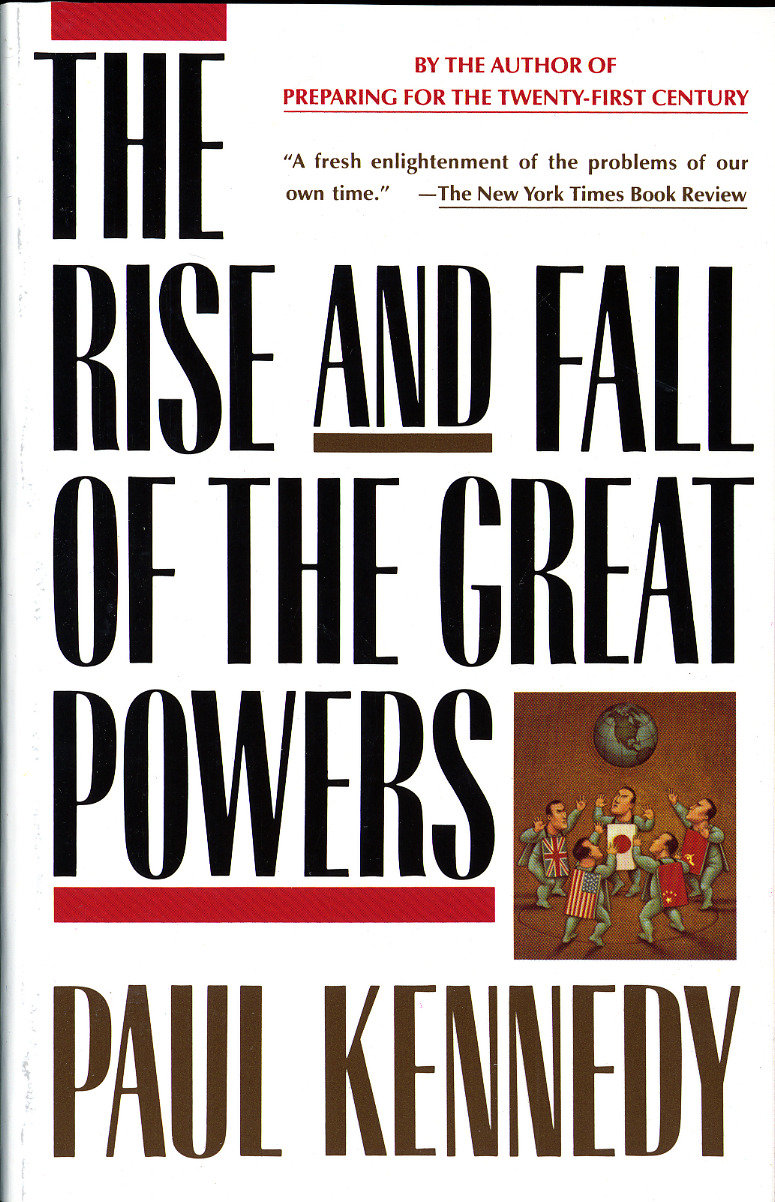
The Rise and Fall of the Great Powers

The Rise and Fall of the Great Powers

Paul Kennedy (1987)

The Subtitle Is The Argument

The Subtitle Is The Argument

Hey everyone! Ian here! Welcome to our book review of The Rise and Fall of the Great Powers, by Paul Kennedy. The subtitle is the whole argument: Economic Change and Military Conflict from 1500 to 2000. If you have ever watched a country spend itself into trouble while insisting it is still number one, this is the book that put that pattern on the table.

From Wallsend To Yale

Paul Michael Kennedy was born in 1945 in Wallsend, Northumberland. He took a first in history at Newcastle, then a doctorate at St Antony's College, Oxford, under A. J. P. Taylor and John Gallagher. He taught at the University of East Anglia, and in 1983 Yale named him the J. Richardson Dilworth Professor of British History. He still works there on international security and grand strategy. His beat has always been the same: the economic base under the fleet, the army, and the diplomacy. When the base slips, the weight slips with it.

From Wallsend To Yale
Eighth Book Made His Name

Eighth Book Made His Name

Random House published the book in 1987. The hardcover runs 677 pages, ISBN 0-394-54674-1. A paperback followed in January 1989. It was Kennedy's eighth book, and the one that made his name. It reached number six on the best-selling hardcover list for 1988, won the Wolfson History Prize that same year, and has been translated into more than twenty languages. Taylor called it an encyclopaedia in itself. Sir Michael Howard called it a deeply humane book in the very best sense of the word.

Power Only Means Relative

Spoilers ahead, if a history of five centuries can be spoiled. Kennedy's thesis is simple and ruthless. A great power's strength is only meaningful relative to the other powers. Over the long run, ascendancy tracks resources and economic durability. The consistent threat is military overstretch: ambitions and security promises bigger than the resource base can carry.

Power Only Means Relative
Uneven Growth Moves Rankings

Uneven Growth Moves Rankings

On page fifteen of the introduction he writes that the relative strengths of the leading nations never remain constant, principally because of the uneven rate of growth among different societies, and because technological and organizational breakthroughs favor one society over another.

Peacetime Changes The Position

He also insists you cannot separate the fighting from the accounts. The triumph of a great power, or the collapse of another, usually follows lengthy fighting. It also follows how efficiently that state used its productive resources in wartime, and, further back, whether its economy had been rising or falling relative to the other leading nations in the decades before the war. How a power's position changes in peacetime matters as much as how it fights.

Peacetime Changes The Position
Fifteen Hundred And The Habsburgs

Fifteen Hundred And The Habsburgs

The book opens at 1500, on the line between the Renaissance and the early modern world. Kennedy glances at the Ming and the Muslim worlds, then at the rise of the western powers relative to them. Chapter two is the Habsburg bid for mastery, from 1519 to 1659. This is not a story of genius versus fools. He says there are no stunning contrasts. Success and failure are measured by very narrow differences. Every state, even the Dutch, was strained by the constant drain of war. The anti-Habsburg side won a marginal, relative victory.

Only Just Held Balance

On page 72 he writes that they had managed, but only just, to maintain the balance between their material base and their military power better than their Habsburg opponents. On page 71 he puts the cost in one line. Military and naval endeavors may not always have been the raison d'être of the new nation-states, but they were certainly their most expensive and pressing activity. That sentence is the spine of the book. It stays true until the power declines. Declining countries then have a harder time balancing guns, butter, and investment.

Only Just Held Balance
British Credit Won Wars

British Credit Won Wars

From 1660 to 1815, Kennedy argues, financial power decides wars. Britain and France could pay for them. Others needed a patron. His table of British wartime spending from 1688 to 1815 is the exhibit: total expenditure about 2.29 billion pounds, income about 1.62 billion, and loans covering roughly a third of the bill, year after year. British credit, fused later with industrial strength, is what he treats as the decisive edge over France through the Napoleonic Wars.

Bairoch Numbers Shift Power

Then the Industrial Revolution rearranges the scoreboard. Kennedy leans on Paul Bairoch's numbers. He sets Britain's per capita industrialization in 1900 at 100. Britain moves from 10 in 1750 to 100 in 1900. France moves from 9 to 39. Shares of world manufacturing are even starker. China holds about 32.8 percent in 1750, then falls after the Opium Wars and the Taiping Rebellion to 19.7 percent in 1860 and 12.5 percent in 1880. Britain goes from 1.9 percent in 1750 to 22.9 percent in 1880. The point is not that China vanished.

Bairoch Numbers Shift Power
Giants Can Still Lose

Giants Can Still Lose

The point is relative position. A giant can still be large and lose the race. In the twentieth century he stacks population, urbanization, iron and steel, energy use, and industrial output. The middle powers crack. The world goes bipolar. By 1945 the United States is the only major industrial nation left intact, with high productivity and a huge surplus. Kennedy then traces the relative slide. From the 1960s the American share of world production and trade eases. By the 1980s exports of farm and manufactured goods are under pressure.

Guns Butter And Investment

In a few years the country goes from the largest creditor to the largest debtor, while federal debt grows faster. He calls that the typical problem of a declining hegemon: guns, butter, and investment for growth, all competing, while military commitments spread across every continent except Antarctica, and the hardware gets more expensive.

Guns Butter And Investment
Forecast Of Relative Decline

Forecast Of Relative Decline

Here is the forecast, and it is the part people still fight about. Writing in the late 1980s, Kennedy expects relative decline for both the United States and the Soviet Union. He expects Japan to rise, the European Economic Community to struggle and also to have real potential, and China to become a great power if its economic development holds. He points to Deng Xiaoping's Four Modernizations, agriculture, industry, science, and the military, with the military de-emphasized, while Washington and Moscow are emphasizing it.

Deficit Spending Drives Decline

Continued deficit spending, especially on military build-up, is, in his view, the single most important reason any great power declines.

Deficit Spending Drives Decline
Bases Like Prewar Britain

Bases Like Prewar Britain

He compares the American map of bases to Britain's before the First World War. As military expense grows, investment in growth shrinks. That, he writes, leads to the downward spiral of slower growth, heavier taxes, deepening domestic splits over spending priorities, and a weakening capacity to bear the burdens of defense. His advice to American statesmen, on page 534, is not panic and not denial. Recognize that broad trends are under way.

Manage The Erosion Slowly

Manage affairs so the relative erosion of the United States' position takes place slowly and smoothly, and is not accelerated by policies that buy a short-term advantage at a longer-term cost.

Manage The Erosion Slowly
Each Weapon Generation Costs More

Each Weapon Generation Costs More

He also names an upward spiral in weapons. Each new generation of aircraft, ships, and tanks costs vastly more than the last, even after inflation. A pre-1914 British battleship cost the Admiralty about 2.5 million pounds. By the 1980s a replacement frigate needed about 120 million. State-of-the-art kit pulls away from commercial manufacturing. The desire for the newest weapon is what pushes the bill up.

Five Ideas Worth Keeping

So what should you take from it? Five ideas, not a slogan. Power is relative, not absolute. Uneven economic growth moves the ranking before the war starts. Finance and credit can matter as much as bravery. Overstretch is the repeating failure mode. And decline, if it comes, is something to manage, not something to pretend away. The book has twelve maps, forty-nine tables, and three charts. It is a synthesis, not a pamphlet. That is a strength if you want the mechanism. It is a chore if you want a villain and a tidy ending.

Five Ideas Worth Keeping
Overstretch Is Not A Mood

Overstretch Is Not A Mood

We have not done a book review in a long time, so I pulled this one on purpose. Kennedy's argument about overstretch is the one I come back to whenever people argue about decline as if it were a mood, or a speech, or a single bad decade. He makes you look at the accounts.

Empires Look Invincible Late

Read it if you like history that keeps the ledger open. Skip it if you want a short brief or a morality play. If you stay with it, you will finish knowing why empires look invincible right up to the decade when the numbers have already turned. Thanks for watching, and happy reading!

Empires Look Invincible Late

📚 You Might Also Like

SPQR

SPQR

Mary Beard

How Rome held power, and what the ledger of empire actually cost

Read Review
Chip War

Chip War

Chris Miller

Modern great-power rivalry measured in factories, not speeches

Read Review
Sapiens

Sapiens

Yuval Noah Harari

The long view of how societies scale, then overreach

Read Review
Homo Deus

Homo Deus

Yuval Noah Harari

What a power does after the old threats stop looking fatal

Read Review

💬 Reader Thoughts

Email is required for anti-spam but can be fake if you prefer privacy.

Loading comments...