Hey everyone! Ian here. Welcome...
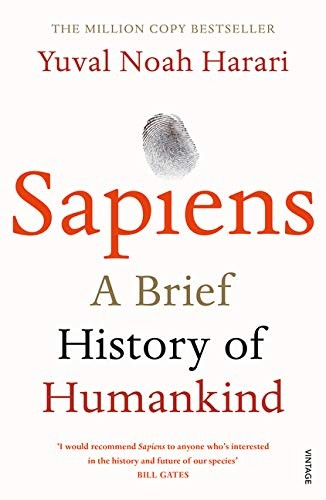
Hey everyone! Ian here. Welcome back to our must-read book review series. Today we’re stepping back to look at the entire sweep of human history through a lens that makes everything from money and religion to empires and modern life feel strangely new. If you’ve ever wondered why we organize ourselves into huge societies, why “progress” often feels like a mixed blessing, or how a not-especially-strong ape species ended up ruling the planet, this book will rewire how
It’s Yuval Noah Harari’s Sapiens...
you see yourself and the world around you. It’s Yuval Noah Harari’s Sapiens: A Brief History of Humankind.The author is Yuval Noah Harari, born in 1976 in Israel. He studied medieval and military history at the Hebrew University of Jerusalem, earned his doctorate at Oxford, and became a professor back at Hebrew University. Sapiens grew directly out of the lectures he gave to undergrads. First published in Hebrew in Israel in 2011, the English edition came out in 2014
At around 443 to 464...
(Harper in the US). At around 443 to 464 pages depending on the edition, it’s a sweeping nonfiction narrative that has sold more than 25 million copies worldwide, been translated into dozens of languages, and earned praise from everyone from Barack Obama to Bill Gates. It sits at a strong 4.33 average on Goodreads from tens of thousands of readers who call it mind-expanding and brilliantly written—even if some academics criticize it for painting history with broad strokes. Either way,
Either way, it launched Harari...
it launched Harari as one of the most influential public intellectuals of our time.Instead of a single plot, Harari tells the grand story of our species in four big movements, each built around a major revolution. He begins about 70,000 years ago with the Cognitive Revolution—the moment when Homo sapiens developed the unique ability to create and share flexible fictions. Suddenly our ancestors could gossip, plan hunts together, and—most importantly—believe in the same myths,
This let small bands of...
gods, and stories. This let small bands of foragers cooperate in ways no other animal could, spreading out of Africa and eventually replacing or outcompeting every other human species on the planet.Next comes the Agricultural Revolution around 12,000 years ago. Humans started domesticating wheat, rice, cows, and sheep. At first glance it looks like progress—more food, bigger populations—but Harari argues it was actually history’s biggest fraud. Farmers worked harder, lived in dirtier, more disease-ridden conditions, and became tethered to their fields and granaries.
Inequality exploded as some people...
Inequality exploded as some people owned land and others didn’t. Yet once we committed to farming, there was no easy way back.From there Harari traces the Unification of Humankind. Over the next few thousand years, three great imagined orders—money, empires, and religions—wove scattered tribes into larger and larger networks. Money turned strangers into trading partners. Empires imposed common laws and languages. Religions gave millions of people a shared story about right
By the time we reach...
and wrong, life and death. By the time we reach the Scientific Revolution just 500 years ago, these forces had created a global civilization. Science, capitalism, and European imperialism exploded outward, remaking the planet with factories, colonies, and unprecedented technological power. Harari brings us right up to the present, showing how these same forces continue shaping who we are today.So what are the five or six biggest ideas that make Sapiens so powerful?
First, everything that lets large...
First, everything that lets large numbers of strangers cooperate—nations, corporations, money, human rights, religions—is a shared fiction that exists only in our collective imagination. As Harari puts it: “There are no gods, no nations, no money and no human rights, except in our collective imagination.” Second, the Agricultural Revolution was history’s biggest fraud: it let us feed far more people, but most of them lived shorter, harder, more miserable lives.
Third, biology enables, culture forbids—our...
Third, biology enables, culture forbids—our bodies and brains were shaped for the Stone Age, so modern life often leaves us anxious, stressed, and strangely unfulfilled. Fourth, human happiness is largely a biochemical affair: “Money, social status, plastic surgery, beautiful houses, powerful positions—none of these will bring you happiness. Lasting happiness
Lasting happiness comes only from...
comes only from serotonin, dopamine and oxytocin.” Fifth, we are the deadliest species in history: long before the Industrial Revolution, Sapiens drove countless plants and animals to extinction and reshaped entire ecosystems. And sixth, our greatest strength is also our greatest danger—we invent stories that let us cooperate on a massive scale, but those same stories can justify
Harari’s central goal is to...
terrible cruelty and ecological destruction. Harari’s central goal is to show that most of what we take for granted about “human nature” or “progress” is actually a very recent cultural invention, and understanding that gives us the power to question it.Some might say a book written in 2011 already feels a little distant with everything that’s happened since, but here’s the honest truth: its big-picture insights into how myths shape reality, how revolutions create winners and losers, and how fragile our shared stories really are feel more urgent and relevant than ever.This book deserves your time because it’s ambitious, provocative, and written in clear, witty, conversational prose that makes 70,000 years of history fly by. Whether you’re a history
Whether you’re a history buff...
buff, a curious general reader, a student trying to make sense of the modern world, or just someone who wants to understand why we do the strange things we do, Sapiens will leave you looking at your morning coffee, your job, your country, and even your own thoughts in a completely new way. It’s one of those rare books that actually changes how you see everything.There you have it—Sapiens: A Brief History of Humankind by Yuval Noah Harari. Grab a copy, settle in, and get ready for the big picture of who we really are. Drop a comment below:
Drop a comment below: which...
which revolution surprised you most—the Cognitive, the Agricultural, or the Scientific? And make sure to subscribe so you never miss our next must-read review. Thanks for watching, everyone—I’ll see you in the next one!
💬 Reader Thoughts
Loading comments...