Book Review

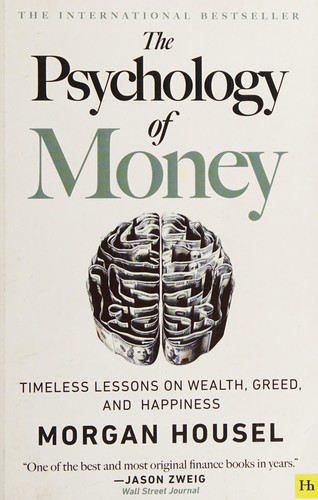
Hey everyone! Ian here! Welcome to our book review. Today we're talking about a book that completely changed how I think about money — The Psychology of Money by Morgan Housel. It came out in 2020 and within weeks became a worldwide phenomenon. And for good reason — it's not about complex formulas or stock picks. It's about something far more important: your relationship with money.
Let me tell you about Morgan Housel. He's a partner at Collaborative Fund, a venture capital firm, and before that he spent years writing for The Motley Fool and The Wall Street Journal, where he wrote the legendary Intelligent Investor column. What makes Housel special is that he's not just a finance guy — he's a storyteller who blends psychology, history, and real-world examples into lessons that actually stick.


His background at the WSJ and Collaborative Fund gave him a front-row seat to how people — from billionaires to everyday savers — make financial decisions. And what he found is that personal finance is more about behavior than it is about math.
So what's the book actually about? The Psychology of Money is structured as nineteen short chapters, each one a standalone lesson about how we think about and interact with money. And the central argument is this: financial success isn't about how smart you are — it's about how you behave. And behavior is harder to teach than formulas. The book opens with the crucial observation that everyone's financial decisions make sense to them based on their unique life experiences.


Your personal experience with money — the inflation you lived through, the market crash you saw, the financial habits your parents modeled — makes up an infinitesimal fraction of global financial history but probably eighty percent of how you think the world works. That's why two reasonable people can look at the same investment and see completely different things.
The book then walks through a series of powerful concepts. There's the difference between being rich and being wealthy. Being rich is what you see — the fancy car, the big house, the expensive watch. But being wealthy is what you don't see — the assets you haven't spent, the savings you've accumulated, the financial independence you've built. Housel calls this the Man in the Car Paradox: when you see someone driving a luxury car, you don't admire the person — you admire the car.


If you want respect, humility and kindness will get you much further than a Porsche.
Then there's the concept of compounding. Housel points out that Warren Buffett's net worth is roughly eighty-four billion dollars, and about eighty-four billion of that came after his fiftieth birthday. Not because he got smarter at fifty — but because he started investing at ten and let compounding do its work for eight decades. The power isn't in being right all the time — it's in being patient most of the time. And the earlier you start, the more time you give compounding to work its magic.


One of my favorite chapters is about luck versus risk. Housel tells the story of Bill Gates and his high school classmate Kent Evans. Gates and Evans were both brilliant students who had rare access to a computer in 1968 — an incredible stroke of luck. But Evans died in a climbing accident before they could start Microsoft together. The same forces — luck and risk — shaped both their futures. The lesson is: be humble about your successes because luck played a role, and be forgiving of your failures because risk played a role.
Never confuse a single outcome with the quality of the decision that led to it.


Another crucial idea is what Housel calls the Room for Error. The most important part of any financial plan is planning for the plan to go wrong. Having a margin of safety — cash reserves, a conservative budget, a buffer — isn't pessimism. It's the only reliable way to navigate a world governed by odds, not certainties. Because if you survive the inevitable setbacks, you stay in the game long enough for compounding to work. And staying in the game is more important than making the perfect move.
Let me give you some of the quotes that really stuck with me. From Chapter Seven: controlling your time is the highest dividend money pays. From Chapter Eighteen: there's no reason to risk what you have and need for what you don't have and don't need. And from Chapter Four: the most important part of every plan is planning on your plan not going according to plan.


Here's why this book deserves your time. The Psychology of Money isn't a typical finance book. It won't tell you what stocks to buy or how to beat the market. Instead, it addresses the psychological traps that cause smart people to make terrible financial decisions. The seduction of pessimism — why bad news sounds smarter than good news. The concept of Enough — why the goalpost keeps moving no matter how much you have.
The difference between reasonable and rational — why paying off a low-interest mortgage early might not be mathematically optimal but might be the best decision for your peace of mind. And the book's ultimate message: getting wealthy and staying wealthy are two completely different skills, requiring opposite mindsets.


This book is for anyone who's ever wondered why they make the financial decisions they do. Whether you're just starting to save or you've been investing for decades, the lessons here are timeless. Morgan Housel wrote this book originally as essays for his own children, hoping they'd learn the psychology of money that schools never teach. And that warmth and clarity comes through on every page.
So here's my honest take. If you read one book about money this year, make it this one. It's not the most technical, it's not the most detailed, and if you've studied behavioral economics you'll recognize some of the concepts. But no other book presents these ideas with such clarity, humanity, and lasting impact. The Psychology of Money will change not just how you invest — but how you think about what money is actually for. Thanks for watching, and happy reading!

Dale Carnegie
Psychology of human behavior and persuasion
Read ReviewExplore more books in the full gallery