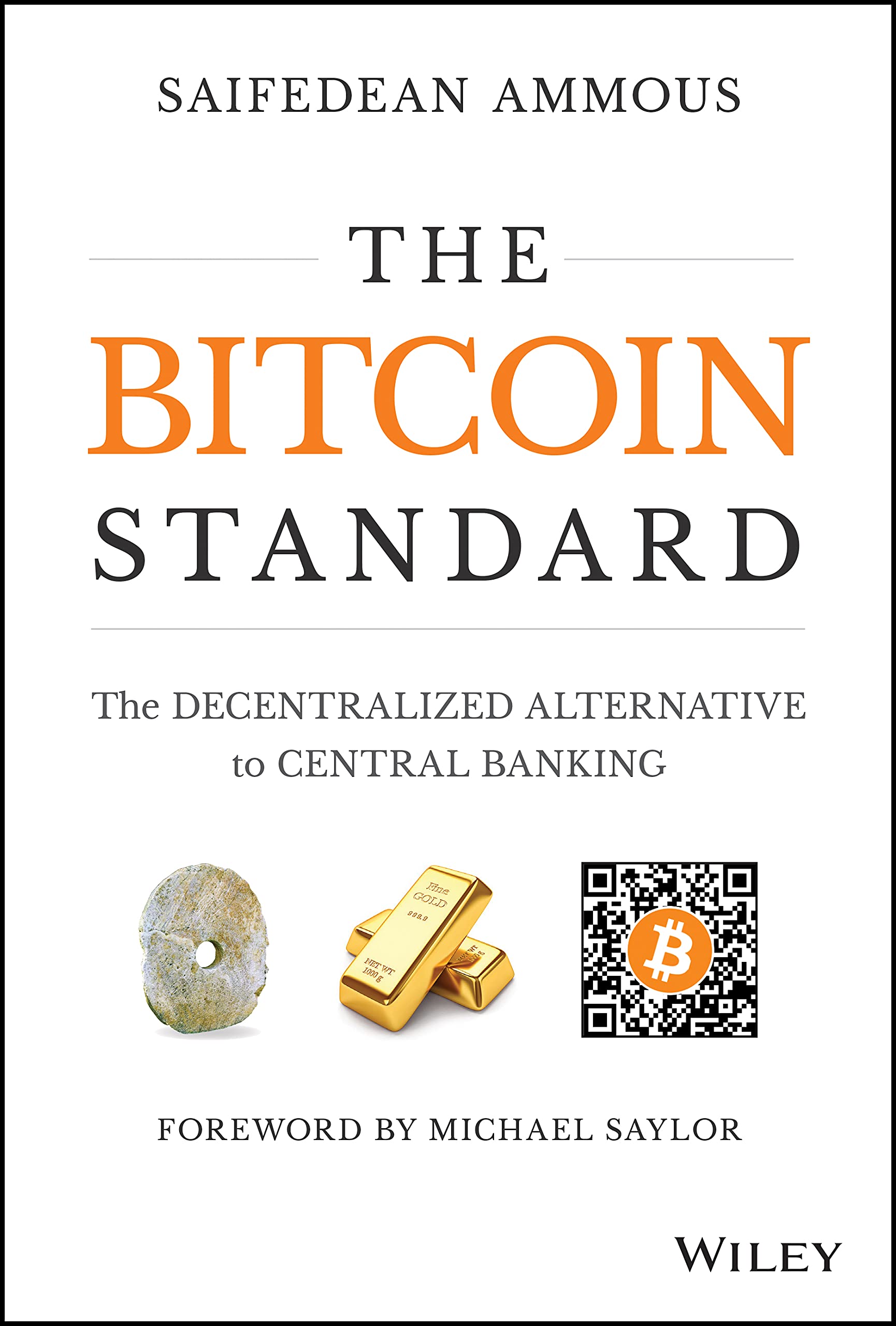
Saifedean Ammous (2018)

Hey everyone, Ian here. Welcome back to our book club. Today we're diving into Saifedean Ammous's The Bitcoin Standard, published in 2018. This isn't just a book about cryptocurrency, it's a sweeping history of money and a bold argument for why Bitcoin matters. Ammous, a Lebanese-American economist, begins by asking a fundamental question: What makes good money?
He traces the evolution of money from barter to cattle, salt, seashells, and eventually precious metals. Throughout history, societies naturally gravitated toward forms of money that best preserve value over time, a property he calls hardness, measured by stock-to-flow ratio.


The central distinction in Ammous's framework is between sound money and easy money. Sound money is costly to produce and resists arbitrary inflation. It imposes fiscal discipline, encourages saving, and enables accurate economic calculation. Easy money, which can be created at will by central authorities, leads to inflation, debt-driven consumption, and misallocation of capital.
A key concept woven throughout the book is time preference, the extent to which individuals value present consumption over future consumption. Ammous argues that fiat money systems raise time preference by eroding savings through inflation, leading to short-term thinking. Low time preference societies, enabled by hard money, tend to invest in long-term capital projects, family structures, and cultural achievements.


Ammous is highly critical of modern central banking. He contends that monetary policy is inherently flawed because it attempts to manage complex economies through politically driven interventions. Artificially low interest rates and quantitative easing distort price signals and redistribute wealth toward the politically connected.
The book's pivotal claim is that Bitcoin represents the first implementation of digital sound money. Its core innovation is resistance to inflation, achieved through a fixed supply cap of 21 million coins, enforced by a decentralized network. Bitcoin's proof-of-work algorithm ensures no central authority can alter its monetary policy. Ammous compares Bitcoin's stock-to-flow ratio to gold, noting that as Bitcoin's block rewards halve approximately every four years, its scarcity actually surpasses that of gold.


By design, Bitcoin is disinflationary, with issuance declining over time until it reaches zero. Ammous dismisses most alternative cryptocurrencies as unsound due to their lack of credible monetary policy. He emphasizes that Bitcoin's value proposition lies not in faster transactions, but in providing a decentralized, immutable, and scarce form of money.
In the final chapters, Ammous speculates on long-term implications. A return to a hard money standard via Bitcoin could restore low time preference behavior, encourage savings, reduce reliance on government debt, and enable bottom-up economic coordination. He argues Bitcoin offers individuals a peaceful exit from centralized monetary control without requiring political revolution.


The Bitcoin Standard is ultimately a thesis on the importance of sound money in shaping human civilization. Thanks for listening.