Walter Isaacson (2014)

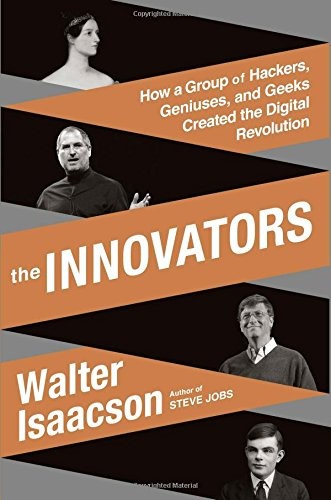
Hey everyone, Ian here. Today we're diving into 'The Innovators' by Walter Isaacson, a sweeping history of the digital revolution from Ada Lovelace to the internet. Isaacson, known for his biographies of Steve Jobs, Albert Einstein, and Leonardo da Vinci, shows us that innovation is rarely the work of lone geniuses—it's a team sport.
The book begins with Ada Lovelace, daughter of the poet Lord Byron, who in the 1840s wrote what we now consider the first computer algorithm for Charles Babbage's Analytical Engine. She envisioned that machines could do more than just calculate—they could compose music, create art, and weave complex patterns, if given the right instructions.


Fast forward a century to Alan Turing, whose theoretical work during World War II laid the foundation for modern computing. His concept of a universal machine that could compute anything computable gave us the blueprint for the digital age. The breaking of the Enigma code wasn't just a wartime victory—it proved that machines could solve problems once thought to be purely human.
After the war, innovation shifted to Bell Labs, where John Bardeen, Walter Brattain, and William Shockley invented the transistor in 1947. This tiny device, which could amplify or switch electronic signals, replaced bulky vacuum tubes and made computers smaller, faster, and more reliable. The transistor is arguably the most important invention of the 20th century.


But transistors needed a way to be connected efficiently. Enter Jack Kilby at Texas Instruments and Robert Noyce at Fairchild Semiconductor, who independently invented the integrated circuit—or microchip—in 1958-1959. By putting multiple transistors on a single slab of silicon, they created the building block of modern electronics. Noyce would later co-found Intel, and the rest, as they say, is Silicon Valley history.
The microchip made computers affordable and accessible, leading to the rise of software as a distinct discipline. Grace Hopper, a rear admiral in the U.S. Navy, developed the first compiler in the early 1950s, translating human-readable code into machine instructions. She also popularized the idea of machine-independent programming languages, which led to COBOL and the notion that software could be written once and run anywhere.


Meanwhile, at Xerox PARC in the 1970s, a group of visionaries invented the graphical user interface, the mouse, and Ethernet. Though Xerox failed to commercialize these ideas, they were adopted by Apple and Microsoft, shaping how we interact with computers to this day. Steve Jobs famously said after seeing a PARC demo, 'Why didn't you do anything with this?'—and then he went on to make the Lisa and Macintosh.
The personal computer revolution of the 1970s and 80s was driven by hobbyists and entrepreneurs. Bill Gates and Paul Allen founded Microsoft to write software for the Altair 8800, while Steve Jobs and Steve Wozniak created Apple I and II in a garage. These machines brought computing into homes and schools, democratizing access to technology.

But computers needed to talk to each other. That's where the internet comes from—a project of the U.S. Department of Defense's ARPANET in the late 1960s. Visionaries like J.C.R. Licklider imagined an 'Intergalactic Computer Network,' and engineers like Vint Cerf and Bob Kahn developed the TCP/IP protocols that became the lingua franca of the net. The internet was designed to be decentralized and resilient, able to withstand even a nuclear attack.
In 1989, Tim Berners-Lee, a scientist at CERN, invented the World Wide Web—a system of interlinked hypertext documents accessible via the internet. He created the first web browser, web server, and the foundational technologies of HTML, HTTP, and URLs. The web transformed the internet from a tool for academics and the military into a global platform for commerce, communication, and creativity.


Isaacson concludes by showing how these innovations build on each other, forming a seamless web of progress. The digital revolution wasn't a series of isolated breakthroughs—it was a collaborative effort spanning generations, disciplines, and continents. As we enter the age of artificial intelligence, the lessons of 'The Innovators' remind us that the future will be built not by solitary geniuses, but by teams who can combine creativity with technical skill, and who understand that innovation is as much about people as it is about technology.
For anyone interested in how we got to where we are today—whether you're a technologist, a historian, or just curious about the forces shaping our world—'The Innovators' offers a rich, deeply human story of the people behind the machines.


Looking ahead, the lessons from 'The Innovators' are more relevant than ever. As we stand on the brink of the AI revolution, we see similar patterns: collaboration across disciplines, the interplay of hardware and software, and the importance of visionaries who can imagine what others cannot. The digital revolution teaches us that the most transformative innovations come not from sudden eureka moments, but from years of tinkering, teamwork, and the willingness to fail and try again.
Isaacson's work reminds us that technology is ultimately a human story. It's about curiosity, passion, and the desire to solve problems that matter. Whether we're building the next generation of AI, editing genomes, or exploring renewable energy, the principles of innovation remain the same: bring together diverse talents, foster environments where ideas can collide, and persist through the inevitable setbacks.


For anyone seeking to understand not just what happened in the digital age, but how to drive meaningful change in any field, 'The Innovators' offers both inspiration and a practical roadmap. It's a testament to what humanity can achieve when we dare to imagine, collaborate, and persist.
Explore more books in the full gallery