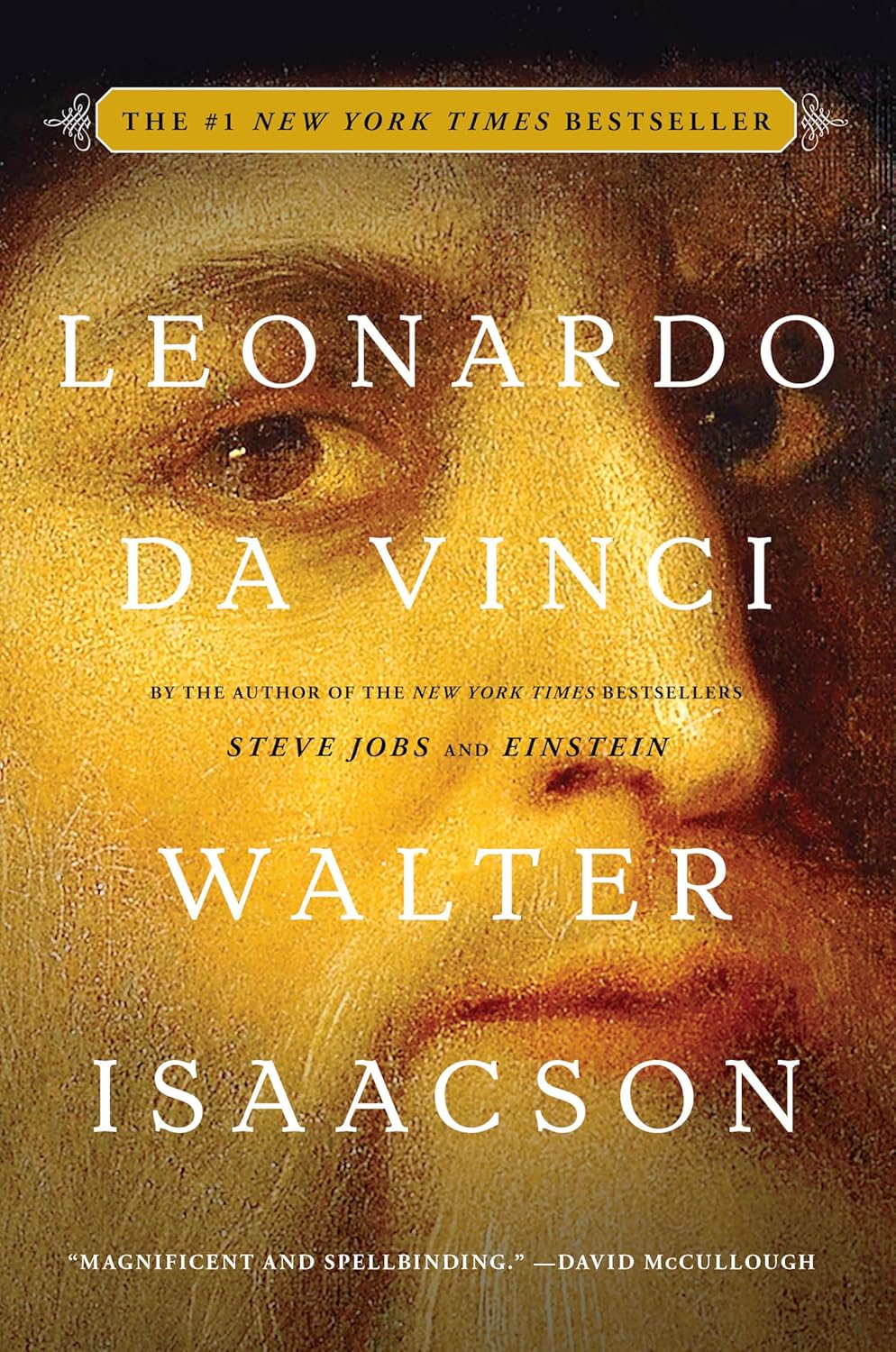
Walter Isaacson (2017)

Hey everyone! Ian here. Welcome to our must-read books review. Picture this: a left-handed, illegitimate kid born in a tiny Tuscan village in 1452 who never went to university, yet ends up painting the two most famous artworks in history, dissecting human corpses by candlelight, sketching flying machines centuries before airplanes, and filling 7,200 notebook pages with questions like "describe the tongue of a woodpecker."
That's the real Leonardo da Vinci you'll meet in Walter Isaacson's gripping biography. If you've ever wondered how one mind could master art, science, engineering, and everything in between—and how you might spark a little of that genius in your own life—stay with me. This book isn't just a life story; it's a masterclass in creativity.


Let's start with the author. Walter Isaacson is the go-to biographer for history's greatest thinkers—he wrote the definitive books on Benjamin Franklin, Albert Einstein (which we reviewed right here), and Steve Jobs. A former Time magazine editor and CNN CEO, Isaacson has a gift for turning complex lives into page-turners that show how genius connects to everyday human traits.
In 2017, armed with fresh discoveries about Leonardo and direct access to those astonishing notebooks, he delivered this 624-page masterpiece. Published by Simon & Schuster on October 17, 2017, it became a #1 New York Times bestseller. Critics raved: Kirkus called it "totally enthralling, masterful, and passionate" and named it one of the best books of 2017. Goodreads sits at a solid 4.18 from tens of thousands of readers, with Bill Gates calling it one of his favorites.


Now, the full story. Isaacson takes us chronologically through Leonardo's extraordinary life, starting with his outsider beginnings. Born out of wedlock in Vinci to a notary father and a peasant mother, young Leonardo was never pushed into the family profession. Instead, at fourteen he was apprenticed to the artist Andrea del Verrocchio in Florence. There he learned to paint, sculpt, and observe the world with obsessive precision.
By his twenties he was already standing out—left-handed, vegetarian, flamboyantly dressed, and openly gay in a time when that was risky. He finished few works because his mind raced ahead to the next obsession. In 1482 he moved to Milan, pitching himself to the Duke as a military engineer (even though he'd never built a weapon).


That's where he painted The Last Supper, turning a simple biblical scene into a psychological drama of motion, emotion, and light. Meanwhile his notebooks exploded: anatomy studies from illegal dissections, designs for tanks and helicopters, geological theories about fossils, and endless experiments on optics and fluid flow. He returned to Florence for a few years, creating the Mona Lisa—that enigmatic smile born from years of studying facial muscles and light rays.
He worked for the ruthless Cesare Borgia as a military cartographer, then briefly in Rome, before King Francis I invited him to France for his final years. There, at age sixty-seven in 1519, he died in the king's arms, still clutching notebooks filled with unfinished ideas. Throughout, Isaacson weaves in deep dives into specific masterpieces and obsessions—Vitruvian Man, bird flight, the human heart, geology—so you feel like you're inside Leonardo's restless mind.


That brings us to the book's six big key points and Isaacson's central goal. First, genius is built on relentless curiosity. Leonardo's notebooks were basically lifelong to-do lists. One entry: "Describe the tongue of the woodpecker." Isaacson shows how that childlike wonder never faded. Second, observation plus imagination is the ultimate creative formula. Isaacson writes, "Leonardo knew how to marry observation and imagination, which made him history's consummate innovator."
Third, art and science are two sides of the same coin. His anatomy studies made the Mona Lisa's smile human; his optics made light dance in The Last Supper. Fourth, being a misfit is a superpower. Illegitimate, easily distracted, heretical—Leonardo thrived on it. Isaacson argues his outsider status freed him to question everything.


Fifth, embrace uncertainty and keep learning. "The outlines of reality are inherently blurry," Isaacson says, "leaving a hint of uncertainty that we should embrace." And sixth, creativity comes from connecting everything. Leonardo jumped between disciplines because "everything connects to everything else." Isaacson's goal? To prove that Leonardo's genius wasn't superhuman—it was human skills we can all cultivate: stay curious, think visually, go down rabbit holes, respect facts, and think different. He absolutely nails it.
So why does this book deserve your time? It's honest, inspiring, and surprisingly practical. Strengths? Gorgeous illustrations, crystal-clear writing, and a perfect balance of personal drama and intellectual fireworks. You'll finish not just knowing Leonardo but feeling like you can borrow his mindset. Perfect for art lovers, science nerds, entrepreneurs, or anyone who feels a little scattered or rebellious.


Even if you've seen the Mona Lisa a hundred times, you'll never look at it—or the world—the same way again. In 2026, with AI and innovation moving so fast, this reminder that cross-disciplinary curiosity still rules is pure gold.
In the end, Leonardo da Vinci isn't just a biography—it's an invitation to live with more wonder. If you want to spark your own creativity, question everything, and see beauty in the connections between art and science, grab this book today. Hardcover, paperback, or audiobook—any version will change how you see the world. Drop your favorite Leonardo fact or lesson in the comments, smash that like button if this fired you up, and subscribe for more must-read deep dives. Ian here—thanks for watching. Stay curious, stay connected. See you next time!