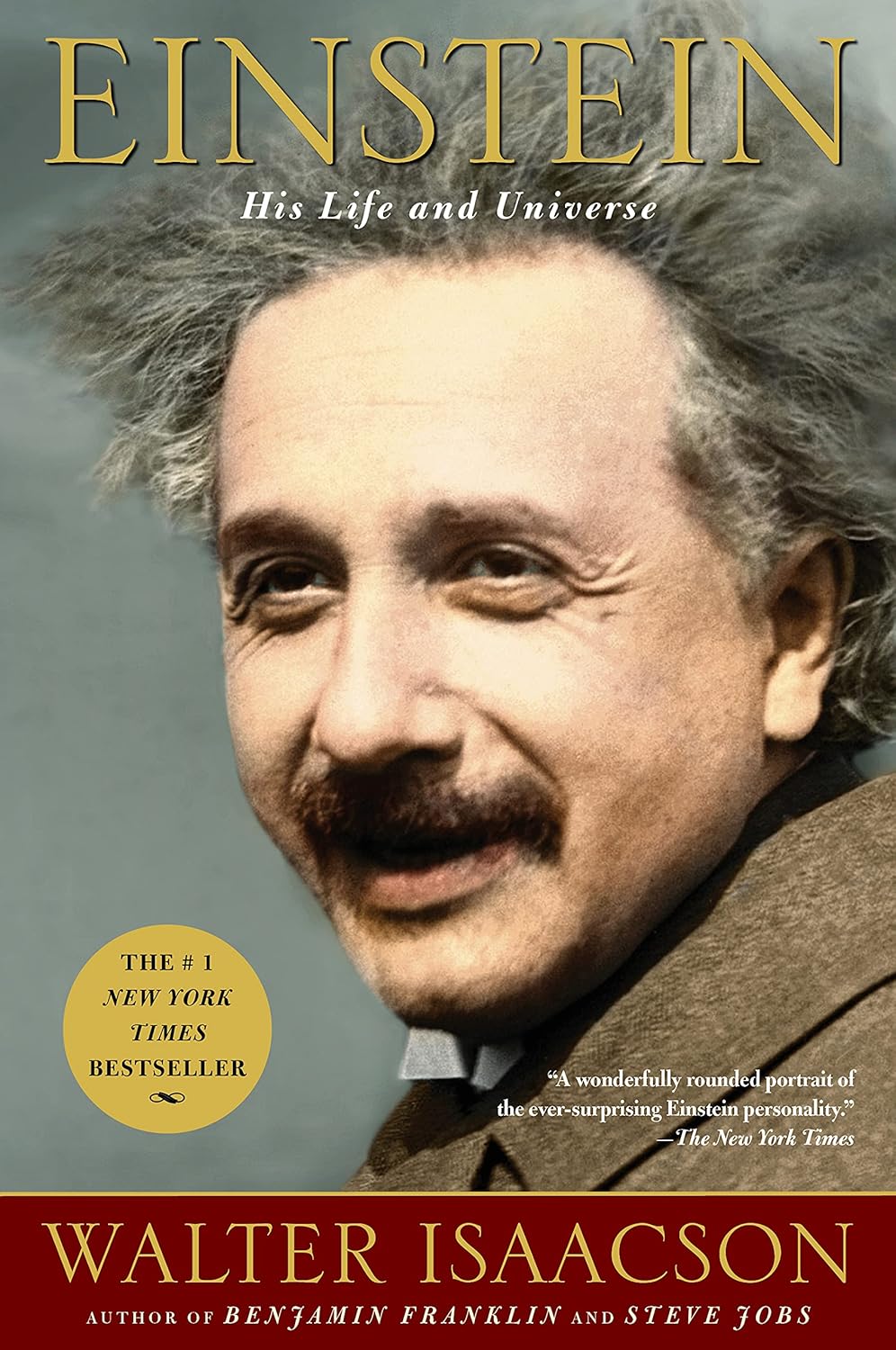
Imagine a Rebellious Patent Clerk
Hey everyone! Ian here. Welcome to our must-read books review. Imagine a rebellious patent clerk in 1905 who, with zero lab equipment and a head full of thought experiments, rewrites the laws of the universe. What if the same guy who couldn't land a teaching job ends up becoming the most famous scientist in history, while wrestling with two messy marriages, fleeing the Nazis, and regretting his role in the atomic bomb? That's the real Albert Einstein you'll meet in Walter Isaacson's Einstein: His Life and Universe.
About the Author
Stick around. This biography doesn't just explain relativity. It shows how one stubborn, wildly curious mind changed everything. Let's talk about the author first. Walter Isaacson is the master biographer behind best sellers like Benjamin Franklin and later Steve Jobs, a former time magazine editor and CNN CEO. He specializes in turning complex lives into page turning stories that connect genius to the real world. In 2007, fresh off the release of thousands
A Quirky Childhood
of newly available Einstein letters and papers, Isaacson set out to write the definitive biography, published by Simon and Schuster on April 10, 2007, this 675 page nonfiction masterpiece blends science history and intimate personal drama. It's not just another hero worship book. It's the first full portrait since all the private documents became public. Critics and readers loved it. 4.17 average on goodreads from hundreds of thousands of ratings with praise from physicists like Brian Green and Murray Gell Mann calling it accurate, readable, and brilliantly human.
The Miracle Year of 1905
Some noted the science sections get dense, but most agree. It's the gold standard. Now the comprehensive story. Isaacson takes us chronologically through Einstein's entire life, starting with his quirky childhood in late 19th century Germany. Born in 1879 to a middle-class Jewish family, young Albert was slow to talk but obsessed with hidden forces. At four, his father gave him a magnetic compass during a fever. He was mesmerized by the invisible pull. His mother pushed violin lessons and music became his lifelong way to process deep thoughts. School? He hated authority, clashed with teachers, and felt like an outsider traits that would define him.
Global Celebrity
By his teens, the family moved to Italy. But Einstein headed to Switzerland for the elite Zurich Polytechnic. There he met Maleva Merrick, his first wife, and fellow physics student. After graduating, he couldn't get an academic job. The only one in his class left out. So he landed a safe gig at the Swiss Patent Office in Bern. That's where the magic happened. In his miracle year of 1905, while still a nobody, he published four groundbreaking papers, one proving atoms exist via Brownian motion,
The 1930s Brought Darkness
one on the photoelectric effect, which later won him the 1921 Nobel Prize, not relativity, by the way, and the twin pillars of special relativity, showing that space and time are relative, the speed of light is constant, and mass and energy are equivalent in that famous equation, E equals MC squared. Success followed fast, he earned his doctorate, climbed the academic ladder to Berlin, and in 1915, unveiled general relativity, explaining gravity as the curvature of spacetime. Fame exploded after a 1919 solar eclipse proved his theory right, but personal life was messy,
Key Points: Curiosity & Rebellion
a difficult divorce from Maleva, they had two sons, a daughter's fate remains unclear, then marriage to his cousin Elsa. World War I turned him into a vocal pacifist. By the 1920s, he was a global celebrity, lecturing, playing violin at salons, and debating quantum mechanics with Niels Bohr. He famously rejected the idea that God plays dice with the universe. The 1930s brought darkness. As a Jew, he fled Nazi Germany in 1933,
Key Points: Unification & Humanity
for Princeton's Institute for Advanced Study. He signed the famous letter, urging President Roosevelt to start atomic research, yet later called it his greatest regret when the bomb dropped on Hiroshima and Nagasaki. In America, he championed civil rights, pushed for a world government, supported Zionism,
Key Points: Mystery & Timelessness
but hated nationalism, and kept chasing his holy grail, a unified field theory that would tie gravity and electromagnetism together. He worked right up to his final days. In April 1955, at age 76, he died after refusing surgery for an aortic aneurysm, leaving behind 12 pages of equations and a legacy that still shapes physics, philosophy, and our view of the cosmos. That brings us to the book's five big key points and Isaacson's central goals. First, Einstein's genius came from relentless childhood curiosity and imagination.
Why This Book Deserves Your Time
He once said, "I have no special talents. "I am only passionately curious." Isaacson shows how that sense of wonder sparked by the compass in violin never faded. Second, rebellion and nonconformity were his secret weapons. Questioning authority let him overthrow Newtonian physics. Isaacson argues this insolent streak is exactly what made breakthroughs possible. Third, unification was Einstein's lifelong obsession in science, his unfinished unified field theory,
A Love Letter to the Independent Mind
and in life he dreamed of one world government and global peace. Fourth, science must serve humanity. He believed concern for making life better for ordinary humans must be the chief object of science and he lived it through pacifism and civil rights. Fifth, awe and mystery are the true roots of religion and discovery. Einstein declared, "The most beautiful emotion we can experience "is the mysterious. "This is religiousness." In this sense only, I am a devoutly religious man. And sixth, creativity and freedom are timeless. Isaacson's goal to prove that Einstein's rebellious personality and imaginative spirit are exactly what we need in our globalized world. He nails it making dense physics accessible while never sugar-coding the man's flaws as a husband and father. So why does this book deserve your time? It's honest, inspiring, and surprisingly relevant. Strengths Isaacson weaves personal letters. Science and history into a gripping narrative that feels like a novel. You'll finish understanding not just relativity but why curiosity, independence, and moral courage still matter in 2026. Perfect for science fans, history buffs, or anyone who wants to feel that spark of wonder again, even if the physics gets technical, the human story carries you through. It's long but never boring and it'll make you see the world differently. In the end, Einstein. His life in universe isn't just a biography, it's a love letter to the power of an independent mind. If you want to be reminded why questioning everything and staying curious can change the universe, grab this book today, pick up a copy, hard cover, paperback or audiobook, and thank me later. Drop your favorite Einstein moment in the comments. Hit that like button if this hooked you and subscribe for more must read deep dives. Ian here, thanks for watching. Keep wondering, keep moving. See you next time.
💬 Reader Thoughts
Loading comments...