














← Back to Gallery
0 / 19
0:00 / 7:23
Suicidal Empathy

Suicidal Empathy

Book Review

A Controversial Wake-Up Call

A Controversial Wake-Up Call

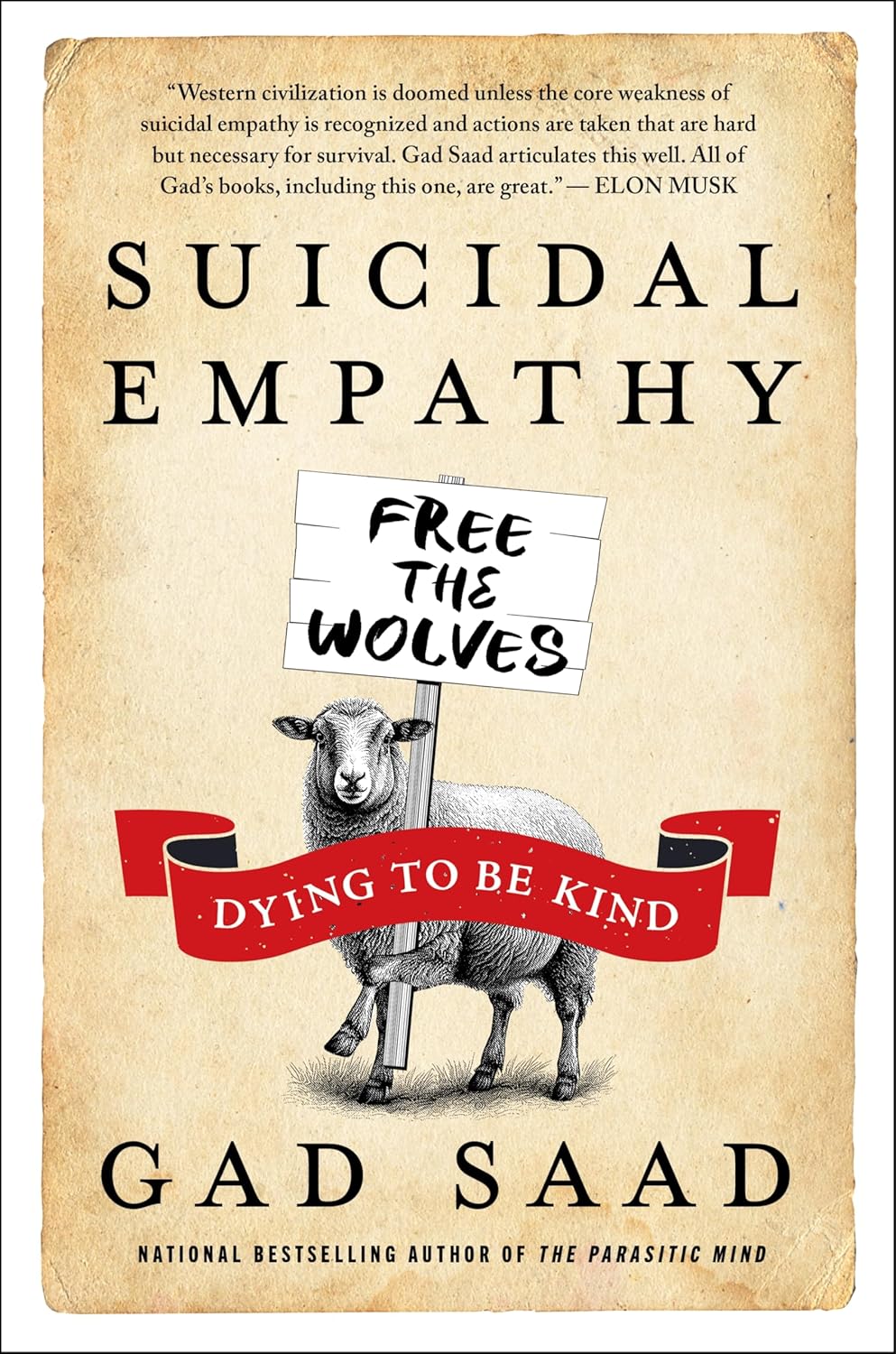
Hey everyone! Ian here! Welcome to our book review of Suicidal Empathy: Dying to Be Kind by Dr. Gad Saad. This is one of the most controversial and talked-about non-fiction releases of the decade, a book Elon Musk has publicly told his followers to read and pass on to all their friends. So what is suicidal empathy, and why does Saad think it could be the end of Western civilization?

Meet Dr. Gad Saad

Let's start with the author. Gad Saad was born in Beirut, Lebanon, in 1964. He's a Lebanese-Jewish Canadian who fled the Lebanese Civil War as a child, eventually settling in Montreal. He earned his MBA at McGill, then a PhD at Cornell, and he's been a professor of marketing at Concordia University since 1994, where he held the Concordia Research Chair in Evolutionary Behavioural Sciences.

Meet Dr. Gad Saad
The Saad Truth Bestseller

The Saad Truth Bestseller

He's the host of The Saad Truth podcast, and his previous book, The Parasitic Mind: How Infectious Ideas Are Killing Common Sense, became an international bestseller.

Empathy Weaponized Against Reason

Suicidal Empathy was published by Broadside Books and Regnery, and it's already been called a wake-up call by everyone from Matt Ridley to Jordan Peterson. The book's core thesis is bold and uncomfortable: empathy, the very virtue we celebrate as the highest moral good, can become weaponized, irrational, and ultimately self-destructive when it overrides reason and self-preservation.

Empathy Weaponized Against Reason
Defining Suicidal Empathy

Defining Suicidal Empathy

So what exactly is suicidal empathy? Saad defines it as the inability to implement optimal decisions when one is psychologically conditioned to prioritize empathy, or displays of empathy, over a rational course of action. In plain English: it's what happens when our compassion circuit gets hijacked and we start making choices that destroy the very people, communities, and civilizations we claim to love.

A Civilizational Disease Diagnosed

A heads-up for spoilers ahead, since this is a non-fiction work of argument, we'll be walking through Saad's case in full. The book is structured as a blistering diagnostic of what Saad sees as a civilizational disease. He draws on evolutionary psychology, behavioral science, and his own life experience surviving sectarian violence in Lebanon to argue that the West has lost its survival instincts.

A Civilizational Disease Diagnosed
Empathy's Evolutionary Misfire

Empathy's Evolutionary Misfire

Saad opens by tracing empathy's evolutionary origins. Empathy is genuinely adaptive. It helped our ancestors care for offspring, build coalitions, and maintain cooperation in small tribes. But like any cognitive module, it can misfire. Saad argues empathy was calibrated for face-to-face interactions within your in-group, not for abstract global compassion broadcast through social media. When you scale it up beyond its natural limits, you get pathology.

The Disease In Action

He then catalogs example after example of what he calls the disease in action. Open border immigration policies that prioritize the feelings of those crossing over the safety of citizens already there. Soldiers receiving less public sympathy than the gang members they fight. Violent criminals released because punishment is deemed cruel. Universities lowering academic standards to spare feelings. Parents affirming every identity claim their children make without question.

The Disease In Action
Survival Logic Overridden

Survival Logic Overridden

In each case, Saad argues, the empathetic instinct has been weaponized to override basic survival logic.

Ordo Amoris and Order

The most provocative chapters tackle what Saad calls ordo amoris, the medieval Catholic doctrine of properly ordered love, which says you should love your family before your neighbors, your neighbors before strangers, and your countrymen before foreigners. Saad argues this isn't selfishness, it's the only sustainable architecture for a functioning society. When you invert that hierarchy, when you love strangers more than your own children, the whole structure collapses.

Ordo Amoris and Order
Parasitic Ideas In Academia

Parasitic Ideas In Academia

Saad reserves special fire for what he calls the parasitic ideas in academia. He spent his career inside the university system and watched it transform from a place of rigorous inquiry into what he calls an idea pathogen incubator. Concepts like equity, lived experience, and standpoint epistemology, he argues, are mental viruses that infect young minds and disable their capacity for clear thinking. The empathy module, once infected, can no longer distinguish between genuine victims and strategic claimants of victimhood.

Quotes That Define It

One of the book's central quotes captures the thesis: "Western civilization is doomed, unless the core weakness of suicidal empathy is recognized and corrected." Another striking line: "It is not empathy itself that is the disease, but empathy unmoored from reason, self-preservation, and reciprocity." Saad isn't anti-empathy, he's anti-pathological empathy. The distinction matters, and critics often miss it.

Quotes That Define It
Lebanon's Cautionary Shadow

Lebanon's Cautionary Shadow

The book draws heavy parallels to Saad's personal history. He survived Lebanon's descent from a prosperous, cosmopolitan Paris of the Middle East into sectarian bloodshed in just a few years. He watched a tolerant society tolerate its own destruction. That memory haunts the entire book. He warns the West that what happened to Beirut can happen anywhere, and faster than you think.

The Critics Push Back

Of course, the book is fiercely contested. Critics from The Guardian, Salon, and The Bulwark have called it a right-wing buzzword dressed up as science, a rebranding of nativist instincts as evolutionary truth. Some historians of psychology argue Saad cherry-picks examples and conflates correlation with civilizational causation. Others note the term overlaps uncomfortably with conspiratorial frameworks like the Great Replacement theory. These are serious critiques and worth wrestling with, whatever side you land on.

The Critics Push Back
Defenders And The Discomfort

Defenders And The Discomfort

But the book's defenders, and there are many, including Matt Ridley, Jordan Peterson, and Elon Musk himself, argue that Saad is naming something real that polite society refuses to discuss. The discomfort the book provokes is, they say, part of the diagnosis.

Questions That Matter Now

So why does this book deserve your time today? Because whatever your politics, Saad is forcing a conversation that most public intellectuals have refused to have. Is there such a thing as too much compassion? Can a virtue, taken to its extreme and detached from reason, become a vice? Can a civilization care itself to death? These are not small questions. They cut to the heart of how we organize societies, raise children, run universities, and choose policies.

Questions That Matter Now
The Honest Reader's Take

The Honest Reader's Take

I'll be honest, I picked this book up expecting to disagree with most of it, and I did disagree with chunks of it. But Saad is a sharp thinker, a clear writer, and a survivor of exactly the kind of civilizational collapse he's warning about. You don't have to share his politics to take the warning seriously. The best reader for this book is someone willing to be uncomfortable, willing to steelman an argument they instinctively resist, and willing to question whether their own kindness has limits they haven't examined.

Pick Up The Book

It's the kind of book that will make you argue out loud with the page. It's also the kind of book that, agree or disagree, you won't forget. If you're tired of intellectual cowardice and want a writer willing to say what others won't, pick up Suicidal Empathy: Dying to Be Kind by Gad Saad. Whether you end up nodding along or throwing it across the room, you'll think harder about empathy, reason, and the survival of free societies than you have in a long time. Thanks for watching, and happy reading!

Pick Up The Book

📚 You Might Also Like
Antifragile

Antifragile

Nassim Nicholas Taleb

How fragile systems collapse when shielded from stress and reality

Read Review
Sapiens

Sapiens

Yuval Noah Harari

The evolutionary roots of human cooperation, empathy, and tribalism

Read Review
Brave New World

Brave New World

Aldous Huxley

A society anesthetized by comfort and the loss of hard truths

Read Review
Animal Farm

Animal Farm

George Orwell

How well-meaning ideals get hijacked into civilizational collapse

Read Review

💬 Reader Thoughts

Email is required for anti-spam but can be fake if you prefer privacy.

Loading comments...