
















← Back to Gallery
0 / 19
0:00 / 7:35
Atomic Habits

Atomic Habits

Book Review

Welcome To The Book Review

Welcome To The Book Review

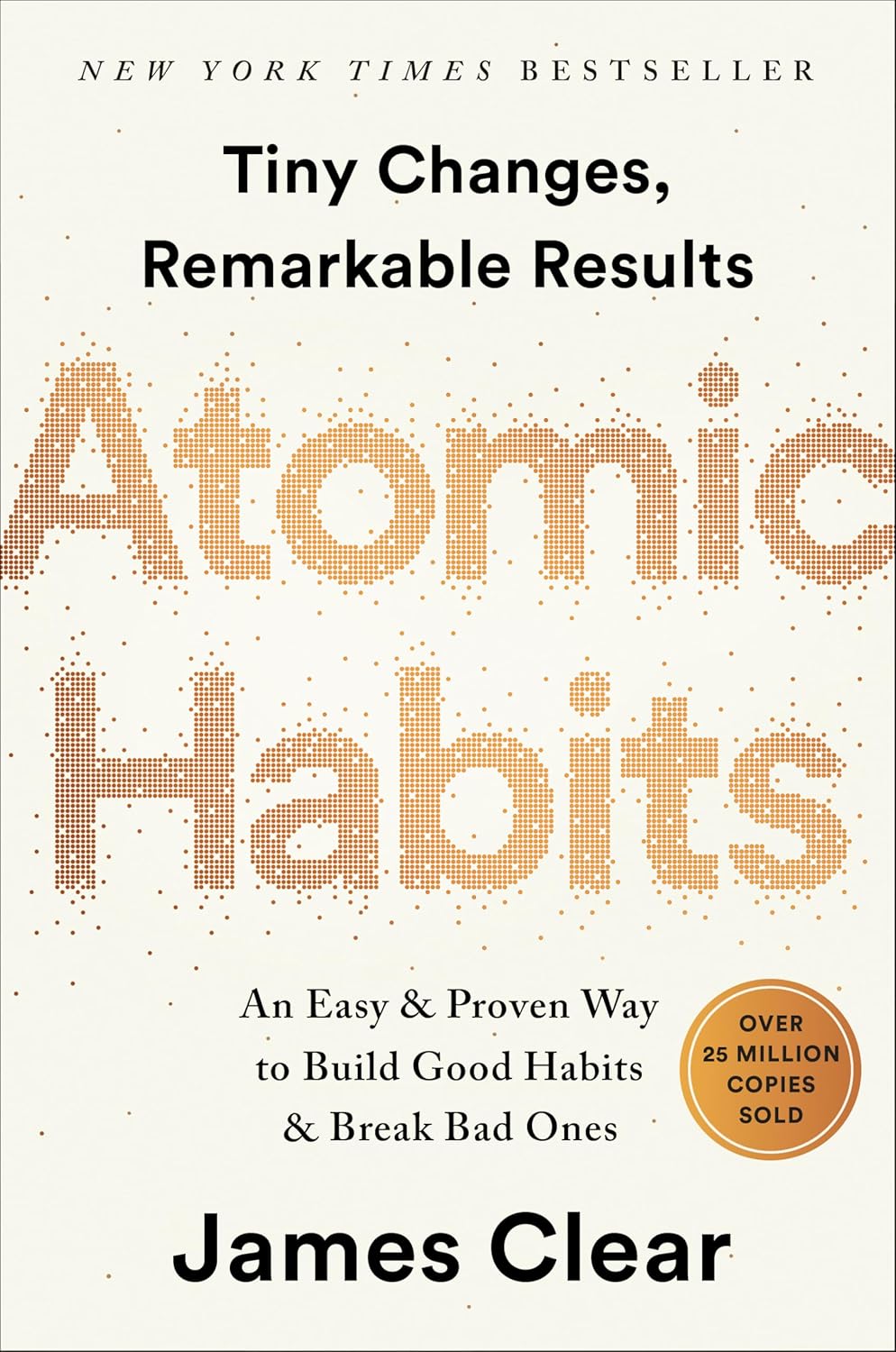
Hey everyone! Ian here! Welcome to our book review. Today we're diving into Atomic Habits by James Clear, published in 2018 by Avery, an imprint of Penguin Random House. Now, before we get into the meat of it, I want to be upfront — I'll be giving away the full framework of this book, including all its key concepts and specific examples. So if you want to go in completely blind, maybe bookmark this for later.

James Clear And His Impact

But honestly, knowing the system beforehand actually makes it easier to apply, and this book is so practical that the real value is in the doing, not the discovering. James Clear is the kind of author who doesn't need a flashy bio to back him up — his work speaks for itself. Born in Ohio in 1986, he studied biomechanics at Denison University, which gave him a systems-thinking approach to human behavior. In 2012, he started a personal blog called jamesclear.com, sharing research-backed articles on habits and continuous improvement.

James Clear And His Impact
A Global Phenomenon

A Global Phenomenon

That blog grew to over 2 million subscribers, and Atomic Habits became an instant phenomenon — over 15 million copies sold, translated into more than 50 languages, and over 100 weeks on the New York Times bestseller list.

Systems Beat Goals Every Time

So what's the core argument of Atomic Habits? Clear's thesis is beautifully simple: you do not rise to the level of your goals. You fall to the level of your systems. Most people focus on outcomes — "I want to lose 30 pounds," "I want to make a million dollars" — but focusing on outcomes is a trap. Real, lasting change comes from focusing on your identity, not your outcomes. You shouldn't say "I want to run a marathon." You should say "I want to become a runner." Because every action you take is a vote for the type of person you wish to become.

Systems Beat Goals Every Time
The Four Laws Framework

The Four Laws Framework

The book is built around a four-stage model of habits called the Habit Loop: cue, craving, response, and reward. This builds on the work of behavioral scientists, but Clear organizes it into the Four Laws of Behavior Change. And here's where it gets really practical.

Make It Obvious

The First Law is Make It Obvious. This is about designing your environment so good habits are easy to see and bad habits are hidden. Clear introduces "habit stacking" — attaching a new habit to an existing one. So instead of saying "I'll read more," you say "After I pour my morning coffee, I will read one page." He also recommends redesigning your physical space: if you want to play guitar more, put the guitar in the middle of your living room. If you want to eat healthier, put fruit on the counter and hide the chips.

Make It Obvious
Make It Attractive

Make It Attractive

The Second Law is Make It Attractive. Humans are driven by dopamine, and we gravitate toward things that feel good. Clear suggests "temptation bundling" — pair an action you want to do with an action you need to do. Love watching Netflix? Fine. But only allow yourself to watch while you're on the treadmill. You can also reframe your mindset: rather than saying "I have to go to work," say "I get to go solve interesting problems today."

Make It Easy

The Third Law is Make It Easy. This is where most people fail. We think we need more motivation, but what we really need is less friction. Clear introduces the Two-Minute Rule: when you start a new habit, it should take less than two minutes. Want to read more? The habit is "read one sentence." Want to write a book? The habit is "write one sentence." The point isn't to finish — it's to show up. As Clear puts it, "The cost of your good habits is in the actions you don't take. The cost of your bad habits is in the actions you repeat."

Make It Easy
Make It Satisfying

Make It Satisfying

The Fourth Law is Make It Satisfying. We are more likely to repeat behaviors when the experience is satisfying. This is where Clear introduces the habit tracker — a simple visual record of your streaks. Every day you complete the habit, you mark an X. "Don't break the chain," he says. But he also introduces a crucial safety valve: "Never miss twice." Missing once is a mistake. Missing twice is the start of a new habit. The goal isn't perfection — it's consistency over time.

Breaking Bad Habits

Now, to reverse these laws for breaking bad habits: Make it invisible, make it unattractive, make it difficult, and make it unsatisfying. If you want to stop checking your phone, leave it in another room. If you want to stop eating junk food, don't keep it in the house. Clear shares his own example: to stop watching so much TV, he unplugged the television after every use. That tiny bit of extra friction — having to plug it back in — reduced his TV time dramatically.

Breaking Bad Habits
Identity Based Change

Identity Based Change

One of the most powerful ideas in the book is the identity-based framework. Clear distinguishes between outcome-based and identity-based habits. Outcome: "I want to lose 20 pounds." Identity: "I want to become the kind of person who never misses a workout." Research shows that when your habits align with your identity, they become self-reinforcing. A smoker who quits by saying "I'm trying to quit" still sees themselves as a smoker. Someone who says "I'm not a smoker" has fundamentally changed their identity.

Who You Believe You Are

The behavior follows naturally from who they believe they are.

Who You Believe You Are
One Percent Better Daily

One Percent Better Daily

And here's the math that makes it compelling. If you get 1% better every day for a year, you end up 37 times better. If you get 1% worse every day for a year, you decline to nearly zero. "It is so easy to overestimate the importance of one defining moment and underestimate the value of making small improvements daily," Clear writes. There is no single moment when you become a writer, a runner, a musician. It is the accumulation of small actions, repeated, over time. As he says: "Habits are the compound interest of self-improvement."

Honest Critique And Limits

Now, the book isn't perfect. Some critics point out that the research citations are sometimes selective — Clear tends to highlight studies that support his framework and doesn't always address contradictory findings. Others note that the examples are sometimes oversimplified. A billionaire who attributes their success to a morning routine may have had advantages you're not accounting for. But even if you take half of what Clear says with a grain of salt, the framework is still enormously useful.

Honest Critique And Limits
The System Simply Works

The System Simply Works

Whether you're trying to build a business, improve your health, write more consistently, or just get out of bed on time, the system works.

How It Changed My Routines

I read Atomic Habits after seeing it recommended everywhere, and it fundamentally changed how I think about daily routines. The Two-Minute Rule alone — just do two minutes — made me stop procrastinating on tasks I'd been avoiding for months. The identity-based framework helped me stop thinking "I want to write more" and start thinking "I am a writer who writes every morning." The environment design tricks, like putting my running shoes next to my bed, made the good habits almost automatic.

How It Changed My Routines
Who This Book Is For

Who This Book Is For

And the "never miss twice" rule saved me from spiraling into guilt every time I skipped a day. Who is this book for? Honestly, almost everyone. If you've ever set a New Year's resolution and abandoned it by February, this book is for you. If you're an athlete looking to optimize your training routine, an entrepreneur trying to build consistent habits around your business, or a parent trying to model good behavior for your kids — James Clear doesn't promise overnight transformation. He promises a system for continuous, compounding improvement.

Your Superpower Is Consistency

And that system, applied consistently, is probably the closest thing to a superpower most of us will ever develop. So that's Atomic Habits by James Clear. Read it. Mark it up. Apply one law this week. Apply another next week. And watch what happens when small improvements compound over time. Thanks for watching, and happy reading!

Your Superpower Is Consistency

📚 You Might Also Like
The Psychology of Money

The Psychology of Money

Morgan Housel

Why our behavior with money reveals deeper patterns

Read Review

The Four Agreements

The Four Agreements

Don Miguel Ruiz

Ancient Toltec wisdom for personal freedom and self-mastery

Read Review
How to Win Friends and Influence People

How to Win Friends and Influence People

Dale Carnegie

Timeless principles for building relationships and influence

Read Review

The Monk Who Sold His Ferrari

The Monk Who Sold His Ferrari

Robin Sharma

A fable about reclaiming your life through daily rituals

Read Review

💬 Reader Thoughts

Email is required for anti-spam but can be fake if you prefer privacy.

Loading comments...