← Back to Gallery
0 / 12
0:00 / 3:47
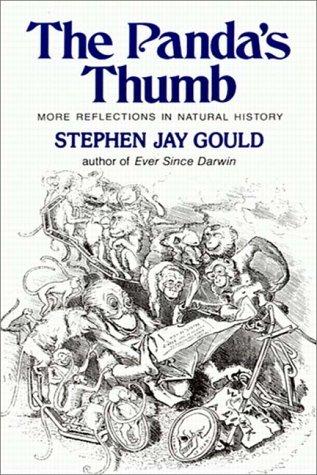
The Panda's Thumb

The Panda's Thumb

More Reflections in Natural History
Stephen Jay Gould (1980)

Introduction

Introduction

Hey everyone! Ian here! Welcome to our book review series. Today we're talking about a book that turns one of nature's clunkiest adaptations into one of the most beautiful arguments for evolution ever written. If you've ever wondered why life is full of quirky, "good enough" solutions instead of perfect designs, this one will change how you see the entire living world.

Meet the Author

Stephen Jay Gould was a Harvard paleontologist, evolutionary biologist, and one of the greatest science writers of the 20th century. He spent decades teaching and writing his monthly column "This View of Life" for Natural History magazine.

Stephen Jay Gould
Book Info

Book Info

The Panda's Thumb: More Reflections in Natural History came out in 1980 from W.W. Norton & Company. It's a collection of 31 lively essays, about 343 pages, and it won the 1981 National Book Award for Science. On Goodreads it holds a strong 4.13 average from thousands of readers. Critics and fans call it witty, profound, and endlessly readable.

The Big Picture

Here's the big picture, completely spoiler-free. This isn't a single story but a delightful tour through the quirks of evolution. Gould opens with the title essay on the giant panda's "thumb"—not a real thumb at all, but an enlarged bone in its wrist that lets it strip bamboo. It's clumsy, jury-rigged, and perfect proof that evolution works with whatever parts are already there instead of starting from scratch.

Big Picture
Essay Topics

Essay Topics

From there the essays fan out: Darwin's own struggles with the evidence, the Piltdown Man hoax, why some animals seem perfectly designed while others look like they were put together on a Friday afternoon, the history of human evolution, misuses of evolutionary ideas in society, dinosaur intelligence, and even Mickey Mouse's changing proportions over the decades.

Five Core Ideas

So what are the core ideas you'll walk away with? Here are the five biggest. First, imperfections are the best evidence for evolution—because a perfect designer wouldn't reuse old parts in weird ways, but history forces life to tinker. As Gould writes, "The panda's thumb demonstrates evolution because it is clumsy and built from an odd part, the radial sesamoid bone of the wrist."

Core Ideas
Second and Third Principles

Second & Third Principles

Second, evolution is not a ladder of progress toward perfection; it's local adaptation using whatever's already available. Third, organisms have deep historical constraints—"Organisms are not billiard balls, propelled by simple and measurable external forces to predictable new positions on life's pool table."

Fourth & Fifth Principles

Fourth, science itself is a human story full of mistakes, biases, and brilliant insights, and we should celebrate its self-correcting power. And fifth, the wonder of natural history lies in its contingencies—life could have gone a million different ways, and the fact that it took this path is what makes it fascinating.

Fourth and Fifth Principles
Gould's Goal

Gould's Central Goal

Gould's central goal? To show that understanding evolution's quirky, historical nature deepens our awe instead of diminishing it. He nails it.

Why Read This Now?

Why does this book deserve your time right now? Because in an age when people still debate design versus evolution, Gould gives you crystal-clear, evidence-based reasoning wrapped in warmth and humor. It's perfect for anyone who loves nature, science, or big ideas—students, curious adults, even folks who think they "don't get" evolution.

Why Read Now
The Writing

The Writing Style

The writing is conversational and fun; you'll laugh, learn, and look at pandas (and your own opposable thumbs) in a whole new light. Some details are dated, but the core message about contingency and wonder is timeless.

Final Thoughts

There you have it—The Panda's Thumb, the book that proves life's little imperfections tell the greatest story of all. Grab a copy today; it'll make you fall in love with evolution all over again. Drop a comment: what's the coolest evolutionary quirk you've ever learned about? Hit like if you're adding this to your list, subscribe for more, and I'll see you in the next one. Stay curious, everyone!

Conclusion