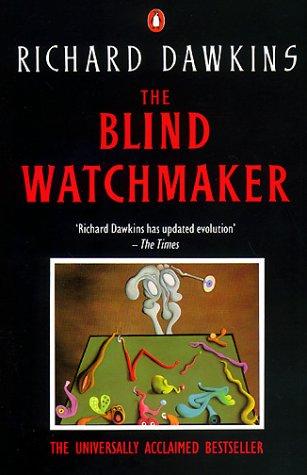
Richard Dawkins (1986)

Hey everyone! Ian here! Welcome to our must-read books series. Today I'm revisiting one of the most important and personally meaningful books in my own scientific journey. This is a book that completely changed how I saw the living world — and it was given to me as a Christmas present by my PhD supervisor during my first year of university. If you've ever looked at the intricate beauty of nature and wondered how it could possibly exist without a designer, this book delivers one of the most elegant, powerful, and mind-expanding answers in all of science.
Richard Dawkins is one of the most influential evolutionary biologists and science communicators of our time. By 1986 he had already shaken the world with The Selfish Gene. The Blind Watchmaker: Why the Evidence of Evolution Reveals a Universe Without Design was published in 1986 by Longman Scientific & Technical (UK) and W.W. Norton (US). It's a beautifully written 332-page masterpiece that won both the Royal Society of Literature Award and the Los Angeles Times Literary Prize in 1987. On Goodreads it holds a strong 4.09 average from over 41,000 readers. It's widely regarded as one of the clearest, most persuasive explanations of how evolution actually works — witty, accessible, and deeply profound.


Here's what the book is really about. Dawkins starts with William Paley's famous 18th-century "watchmaker" argument: if you find a complex watch on the ground, you naturally assume it had a watchmaker. Paley applied the same logic to living things — the eye, the wing, the hand — arguing they must have been designed by a conscious creator.
Dawkins agrees that living organisms give a powerful illusion of design. But he shows that the "watchmaker" is not a deity — it is natural selection, and it is utterly blind. Through brilliant analogies, computer simulations he calls "biomorphs," and crystal-clear explanations, Dawkins demonstrates how tiny random mutations, filtered by non-random survival and reproduction over millions of years, can build astonishing complexity.


He takes you step-by-step through the evolution of the eye, bat echolocation, and other "irreducibly complex" features that creationists often point to. He dismantles the idea that evolution is "just chance" by introducing the crucial concept of cumulative selection — where each small improvement builds on the last.
The book is both a celebration of Darwinian evolution and a passionate defense of it against those who still don't fully understand its power.


So what are the major ideas you'll walk away with? Here are the six biggest ones. First, biology is "the study of complicated things that give the appearance of having been designed for a purpose." Second, natural selection is the blind watchmaker: "Natural selection, the blind, unconscious, automatic process which Darwin discovered... has no purpose in mind. It has no mind and no mind's eye. It does not plan for the future." Third, while mutation is random, selection is the opposite of random — it's a cumulative, non-random filter that preserves what works. Fourth, complex adaptations are built gradually through many small, useful steps, not miraculous leaps. Fifth, the power of deep time and cumulative selection can create what looks like impossible design. And sixth, Darwin's theory isn't just true — it is the only known explanation that can, in principle, solve the mystery of our existence and the existence of complex life. Dawkins' central goal was to show that you don't need a designer to explain the beauty and complexity of life — natural selection is more than enough.

Why does this book still deserve your time — and why does it mean so much to me personally? Because in my first year of university, my PhD supervisor gave me this book as a Christmas gift. It was one of those presents that truly changed how I thought about science and the natural world. Dawkins' writing is so clear and passionate that it made the elegance of evolution click for me in a way no textbook ever had. Even today, it remains one of the best explanations of why evolution is not only true, but beautiful. It's perfect for students, science lovers, or anyone who wants to understand the living world at a deeper level. The writing is sharp, often funny, and incredibly accessible.


There you have it — The Blind Watchmaker, the book that reveals how a blind, unconscious process created all the wonder and complexity of life on Earth. If it was a formative book for you too, or if you're just discovering it now, grab a copy today. You'll never look at a butterfly, an eagle, or your own hand the same way again. Drop a comment: has The Blind Watchmaker ever changed the way you see nature? Hit like if this review brought back good memories, subscribe for more, and I'll see you in the next one. Stay curious, everyone!