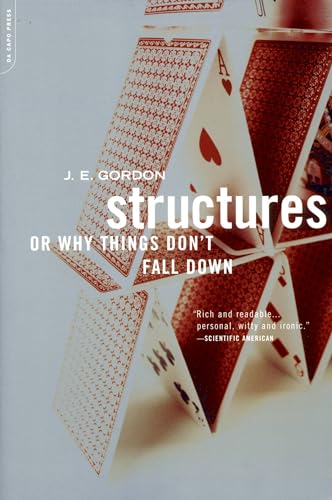








J.E. Gordon (1978)

Hey everyone, Ian here. Welcome back to our book club. Today we're exploring Structures, or Why Things Don't Fall Down by J.E. Gordon, first published in 1978. Gordon was a materials scientist and engineer who worked on aircraft during World War Two. This book is his love letter to structural engineering, written with wit, clarity, and deep expertise. It's one of Elon Musk's recommended reads.
The book opens with a simple question that hides enormous complexity. Why don't things fall down? Bridges stand for decades. Buildings withstand storms. Airplanes stay in the sky. What makes these structures possible?


Gordon explains that all structures are about managing forces. Tension pulls things apart. Compression pushes them together. Shear slides layers past each other. Torsion twists. Bending combines tension and compression. Understanding these forces is the foundation of engineering.
He explores materials. Different materials handle forces differently. Stone and concrete are strong in compression but weak in tension. They work great for columns and arches, but terrible for beams that bend. Steel is strong in both tension and compression. Wood is somewhere in between. Choosing the right material for each part of a structure is crucial.


The book explains why beams work. When you bend a beam, one side stretches in tension while the other compresses. There's a neutral axis in the middle where there's no stress. The farther material is from this neutral axis, the more it contributes to resisting bending. This is why I-beams are shaped like an I. Most material is at the top and bottom, far from the neutral axis, maximizing strength while minimizing weight.
Gordon explores the history of structural engineering. Gothic cathedrals with their flying buttresses. Roman aqueducts with their arches. The Brooklyn Bridge and its suspension cables. Each era solved structural problems with the materials and mathematics available.


He explains why structures fail. Fatigue, where repeated stress causes cracks to grow. Creep, where materials slowly deform under constant load. Buckling, where slender columns suddenly collapse under compression. Understanding failure is as important as understanding success. Gordon says you don't really understand a structure until you know how it breaks.
The book dives into biological structures. Bones are engineering marvels. They're lightweight but strong, self-repairing, and adapt to stress by growing thicker where needed. Trees withstand wind through clever geometry and material distribution. Nature solved structural problems through millions of years of evolution.


Gordon discusses the square-cube law. As things get bigger, volume grows as the cube of linear dimensions, but cross-sectional area only grows as the square. This means large structures face challenges small ones don't. An ant scaled up to elephant size would collapse under its own weight. Engineering must account for scale effects.
He explores composite materials and modern engineering. Fiberglass combines strong glass fibers with flexible resin. Reinforced concrete puts steel rods in concrete to handle tension where concrete is weak. Modern aircraft use aluminum alloys and carbon fiber to achieve strength with minimal weight.


The book explains why joints matter. The strongest material fails if the connections are weak. Rivets, welds, bolts, adhesives. Each has advantages and disadvantages. Gordon tells stories of disasters caused by poor joints, from aircraft crashes to bridge collapses.
He covers pressure vessels and thin-walled structures. Balloons, pressure cabins, pipes. These seem simple but involve complex stress distributions. A spherical pressure vessel is twice as strong as a cylindrical one under the same pressure. These insights guide design of everything from scuba tanks to spacecraft.


Gordon writes with charm and authority. He explains Poisson's ratio, the way materials get thinner when stretched. He explains Young's modulus, the measure of stiffness. He explains safety factors, the margins engineers build in because we can't predict everything. Each concept comes alive through examples and anecdotes.
What makes Structures special is its accessibility. Gordon assumes no prior knowledge but doesn't dumb things down. He builds understanding from first principles. By the end, you understand why bridges don't fall, why airplanes fly, and why buildings stand. Why read this book? Because we live in a built world. Every bridge you cross, every building you enter, every vehicle you ride in, is a structural miracle. Understanding the principles behind them makes you appreciate the invisible engineering that makes modern life possible. And as Elon Musk noted, if you're building rockets or cars, these fundamentals matter.


Thanks for listening, and catch you next time.