Book Review

Hey everyone! Ian here. Welcome back to our must-read book review series. Today we’re tackling a book that somehow squeezes the entire story of the universe, our planet, and life itself into one wildly entertaining ride—and does it without ever making your head spin. If you’ve ever stared up at the night sky wondering how we got here, or felt like science class in school left you more confused than enlightened, this book is going to blow your mind in the best possible way.
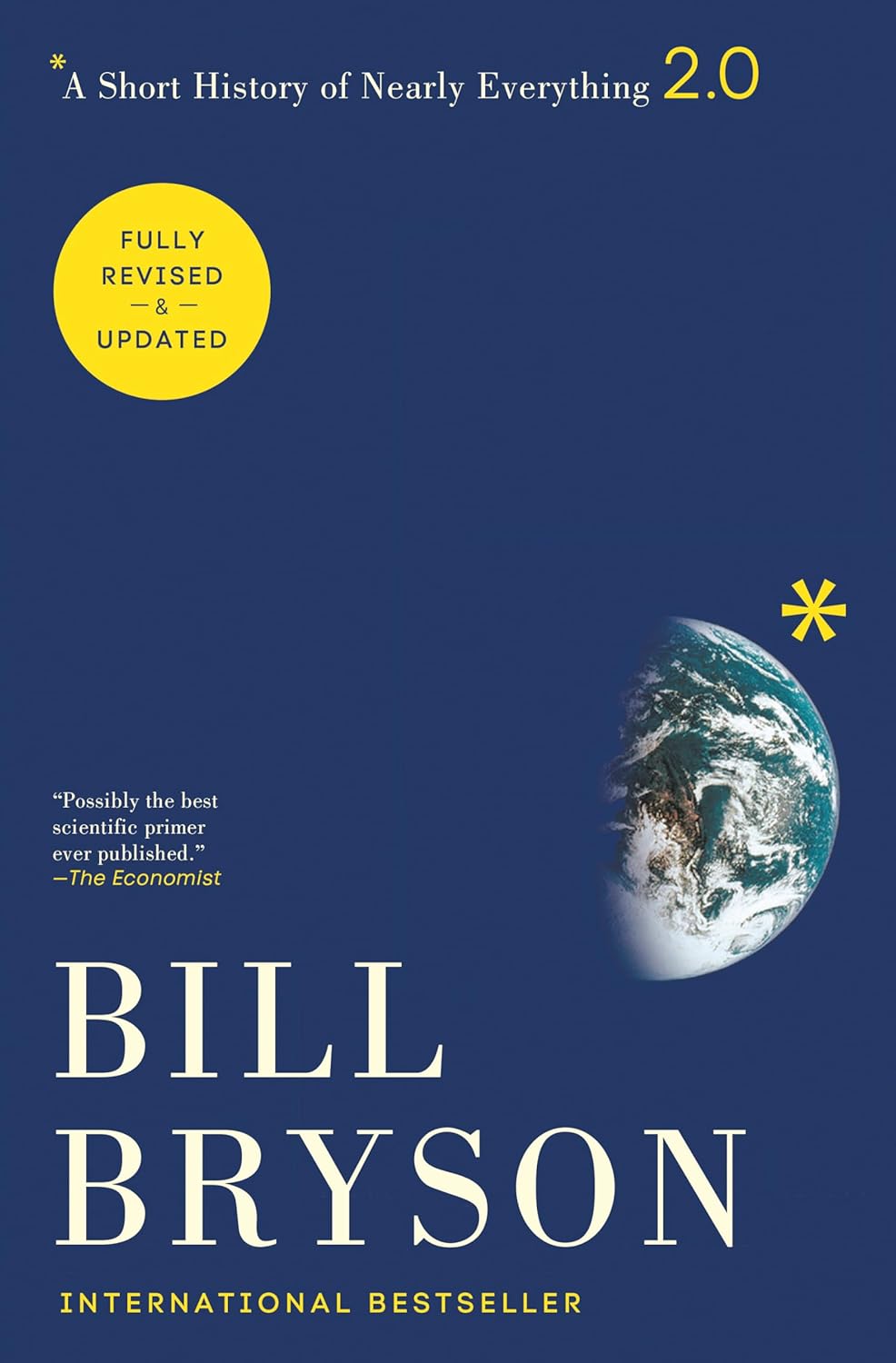
It’s Bill Bryson’s A Short History of Nearly Everything.The author is Bill Bryson, born in 1951 in Des Moines, Iowa. He’s best known for his hilarious travel books like Notes from a Small Island, but in the late 1990s he realized something embarrassing: despite a decent education, he barely understood how the universe or even his own body actually worked. So he spent years traveling the world, interviewing top scientists, and diving into the history of discovery.


The result was this 2003 bestseller—published by Doubleday in the UK and Broadway Books in the US, around 544 to 560 pages depending on the edition. It won the Aventis Prize for Science Books and the Descartes Prize for science communication, and it’s still one of the most beloved popular science books ever written. Goodreads average sits at about 4.22 from hundreds of thousands of readers who call it funny, awe-inspiring, and impossible to put down.Now let’s walk through what’s inside.
Bryson structures the book like a grand adventure, starting at the absolute beginning and working his way forward. In the opening sections he tackles the cosmos—how the Big Bang created everything from nothing, what atoms and protons and quarks actually are, and just how mind-bogglingly huge (and empty) the universe really is.


He takes you on a tour of our solar system, explaining why Earth is such a rare and lucky place, and introduces you to quirky astronomers like the Reverend Robert Evans, who discovered dozens of supernovas from his backyard.Then he shrinks down to Earth itself—measuring its size and age, the wild stories of early geologists who smashed rocks and braved volcanoes to figure out deep time, and the chemical elements that make up everything around us.
Next comes a new age of physics: Einstein’s relativity, quantum weirdness, and the mighty atom, all told with Bryson’s trademark humor about the eccentric geniuses who fought, feuded, and occasionally got things spectacularly wrong.He doesn’t shy away from the dangerous side of our planet either—massive volcanic eruptions, earthquakes, tsunamis, and the very real threat of asteroids or supervolcanoes that could wipe us out tomorrow.


From there he dives into life itself: how the first tiny organisms sparked in ancient oceans, the rise of cells and DNA, evolution’s wild ride through dinosaurs and ice ages, and the incredible biodiversity that still surrounds us. Finally, he brings it all home to us—the mysterious road to modern humans, our restless ape ancestors, and how we fit into this 4.6-billion-year story.
Throughout, Bryson weaves in the human drama behind every breakthrough: the rivalries, the lucky accidents, the forgotten heroes, and the sheer persistence that got us from ignorance to understanding.So what are the five or six biggest ideas that make this book unforgettable? First, we are insanely, ridiculously lucky to be here. As Bryson puts it: “If this book has a lesson, it is that we are awfully lucky to be here—and by ‘we’ I mean every living thing.


To attain any kind of life in this universe of ours appears to be quite an achievement.” Second, not one of your ancestors—from the dawn of life—failed in the exact right way at the exact right moment, or as he writes: “Not one of your pertinent ancestors was squashed, devoured, drowned, starved, stranded, stuck fast, untimely wounded, or otherwise deflected from its life’s quest… in order to perpetuate the only possible sequence of hereditary combinations that could result—eventually, astoundingly, and all too briefly—in you.”Third, everything is connected.
“Every atom you possess has almost certainly passed through several stars and been part of millions of organisms on its way to becoming you.” Fourth, our planet is both generous and ruthless: “It is a curious feature of our existence that we come from a planet that is very good at promoting life but even better at extinguishing it.” Fifth, science is a deeply human story full of flaws and brilliance: “There are three stages in scientific discovery.


First, people deny that it is true, then they deny that it is important; finally they credit the wrong person.” And sixth, we still know so little—which is exactly why the quest feels so exciting. Bryson’s central goal was to make science feel alive, wondrous, and accessible instead of dry and intimidating. He absolutely nailed it.Some might say a 2003 science book feels dated in 2026 with all the new discoveries, but here’s the honest truth: the core wonder and the big-picture story haven’t changed.
Bryson’s gift is showing how science is an ongoing human adventure, and that humility in the face of the unknown is timeless.This book deserves your time because it’s the perfect antidote to feeling small or disconnected in a complicated world. Whether you’re a science lover who wants the full story or someone who always felt left out of the conversation, Bryson makes every page feel like a conversation with the smartest, funniest friend you’ve ever had.


It’s packed with jaw-dropping facts, laugh-out-loud anecdotes, and a genuine sense of awe that sticks with you long after you close the cover.There you have it—A Short History of Nearly Everything by Bill Bryson. Grab a copy, settle in, and prepare to see the world in a whole new light. Drop a comment below: what’s one fact from science that still blows your mind? And make sure to subscribe so you never miss our next must-read review. Thanks for watching, everyone—I’ll see you in the next one!