Richard Dawkins (1976)

Hey everyone! Ian here! Welcome back to our book review. Today we're exploring Richard Dawkins's groundbreaking The Selfish Gene, published in 1976. This book revolutionized how we think about evolution, introducing the gene-centered view that changed biology forever. Whether you're into science or just curious about why life works the way it does, this one's essential.
Richard Dawkins was an ethologist at Oxford University when he wrote this book at age 35. Building on George C. Williams's work and W.D. Hamilton's mathematics of kin selection, Dawkins presented a radical new perspective. Published by Oxford University Press at just 224 pages, The Selfish Gene became an instant classic, translated into over 25 languages and never going out of print. Dawkins later said he wished he'd called it The Immortal Gene because too many people misread the title and thought he was advocating for selfishness in humans.


Dawkins opens with a bold claim: "Intelligent life on a planet comes of age when it first works out the reason for its own existence." That age began when Charles Darwin discovered natural selection. But Dawkins argues Darwin didn't go far enough—he stops at the organism level. Dawkins pushes deeper, to the gene itself.
The core concept is the replicator. In the primordial soup, some molecules became copyable. These first replicators, eventually DNA, discovered the secret of immortality—not living forever, but copying themselves. Dawkins writes: "The gene is the basic unit of selfishness." But here's the twist: genes build survival machines—bodies, behaviors, brains—to preserve and propagate themselves.


What about altruism? How can selfish genes create cooperative behavior? Dawkins devotes a major chapter to kin selection. As W.D. Hamilton showed, genes can promote altruistic behavior if the cost to the giver is less than the benefit to the recipient, discounted by relatedness. A gene for helping siblings can spread if the help costs you less than it benefits them, because siblings share half your genes. Dawkins explains: "We are survival machines—robot vehicles blindly programmed to preserve the selfish molecules known as genes."
The book introduces game theory through evolutionarily stable strategies. In a population of hawks and doves, neither can completely dominate because a 50-50 mix is evolutionarily stable. Too many hawks and doves thrive by avoiding fights; too many doves and hawks exploit them.


Dawkins explores reciprocal altruism—the "tit for tat" strategy where organisms cooperate until betrayed, then retaliate.
Perhaps most famously, Dawkins invented the meme: "a unit of cultural transmission, or a unit of imitation." Just as genes replicate through biological evolution, memes replicate through cultural evolution. Tunes, catch-phrases, ideas, fashions—all spread by imitation. Dawkins writes: "Examples of memes are tunes, ideas, catch-phrases, clothes fashions, ways of making pots or of building arches." Memetics became its own field of study.


Dawkins addresses extended phenotypes—genes expressing themselves beyond the organism's body. Beaver dams, bird nests, spider webs—these are extended phenotypes, part of the gene's influence on the world. The organism is not the unit of selection; the gene is. Bodies are temporary vehicles built by genes for their own preservation.
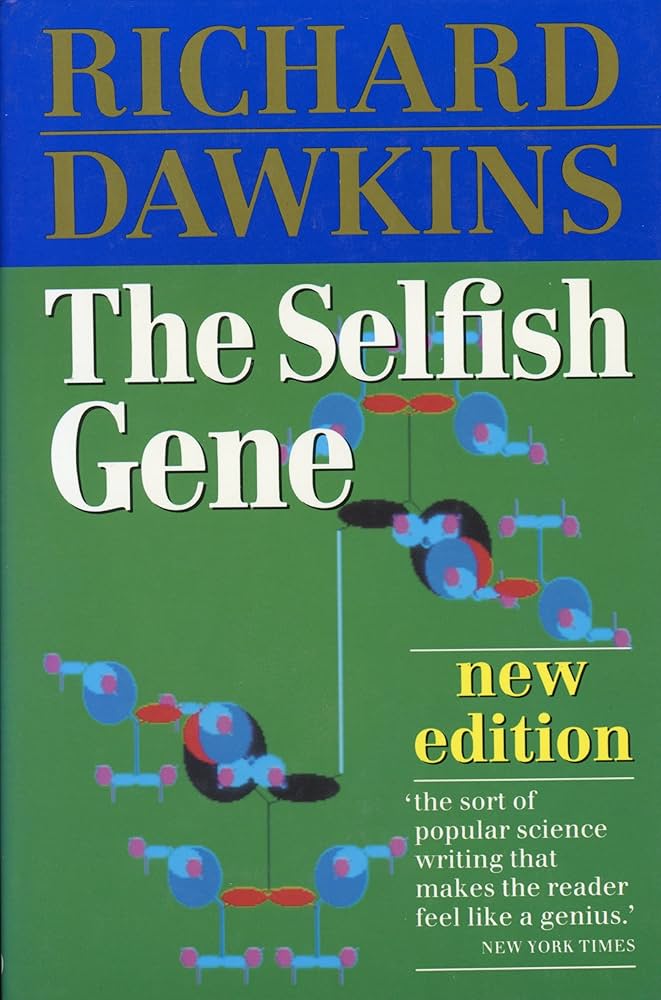
Why read this in 2026? Because The Selfish Gene explains behaviors from altruism to warfare, from ant colonies to human culture, with stunning clarity. It demonstrates how simple rules—replicators competing for survival—generate complexity. The framework underlies modern evolutionary psychology, behavioral economics, even understanding viral content online. The meme concept predicted internet culture decades before social media existed.


Dawkins's masterpiece isn't about selfishness in the moral sense—it's about the mechanics of replication. Understanding that we are gene machines liberates us from biological determinism. As Dawkins writes: "We are built as gene machines and cultured as meme machines, but we have the power to turn against our creators." We can rebel against the tyranny of our selfish replicators. That insight alone makes this book worth your time. Pick it up, dive in, and prepare to see the world differently. Thanks for watching, and catch you next time!