Introduction
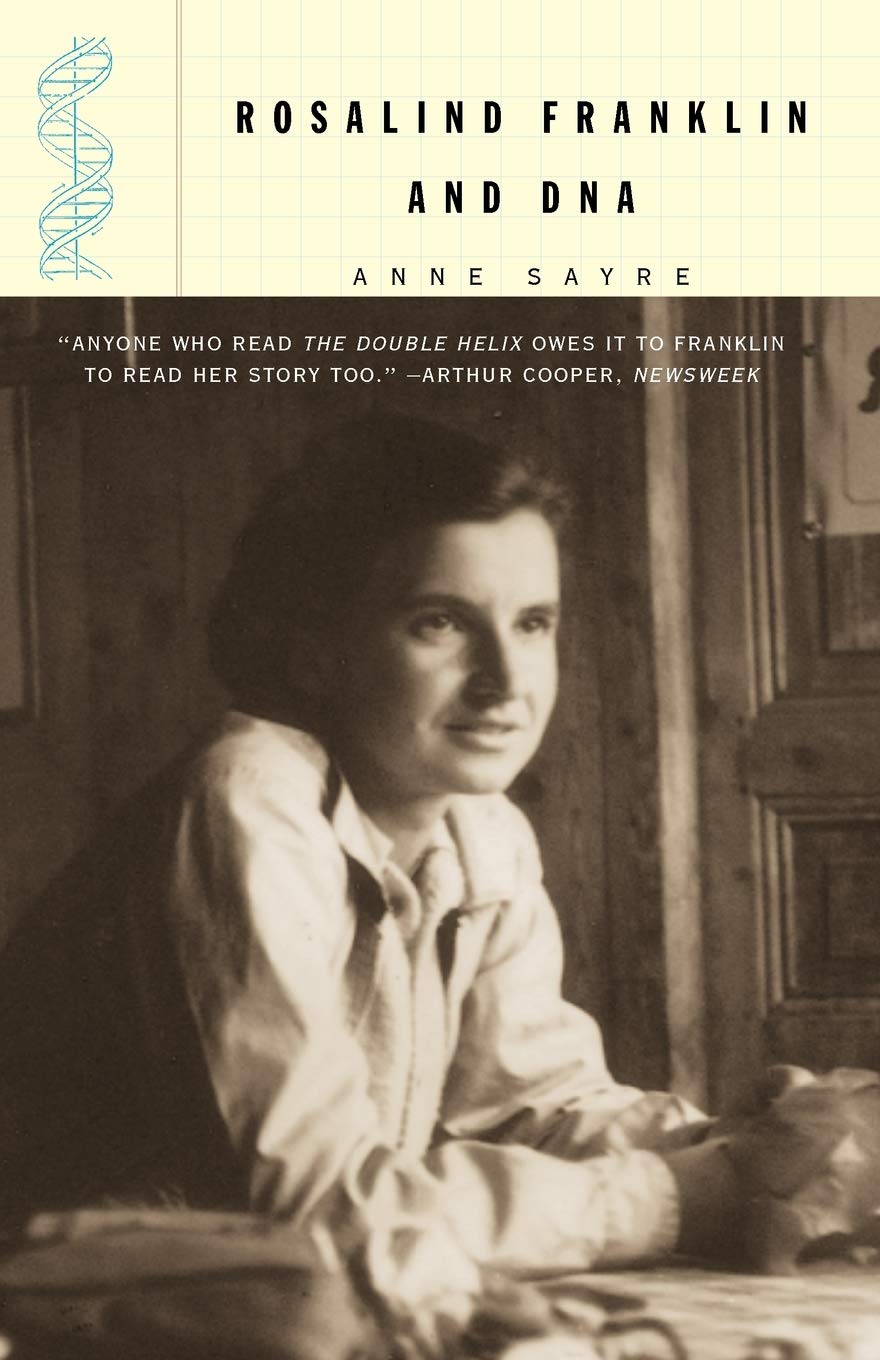
Hey everyone! Ian here! Welcome to our book review books series. If you loved The Double Helix and walked away wondering about the other side of that legendary scientific race—if you've ever sensed that history sometimes gives short shrift to the people who actually did the painstaking work—this book is going to hit you right in the heart and the mind. It's the powerful, long-overdue story of one of the most brilliant and overlooked scientists of the twentieth century, told by someone who knew her best. Let's meet the author first.
Meet the Author
Anne Sayre was an American writer and journalist, a close personal friend of Rosalind Franklin. They met in Paris in 1949 when both their husbands were doing post-doctoral research—Sayre's husband was a crystallographer, so she understood the world Franklin lived in. Sayre wasn't a scientist herself, but after reading James Watson's The Double Helix in 1968 and seeing how unfairly her friend was portrayed, she spent five years researching letters, unpublished notes, and interviewing everyone involved.
The Book
The result is Rosalind Franklin and DNA, published in 1975 by W.W. Norton & Company. It's a compact 222-page biography that reads like a passionate protest and a loving tribute rolled into one. On Goodreads it holds a solid 4.02 average from readers who call it eye-opening and necessary, though some note its emotional tone. Critics at the time praised it as "well-researched and fairly written," and it became a landmark in feminist science writing, helping bring Franklin's real contributions into the spotlight decades after her death.
The Story
Here's the big picture—completely spoiler-free, because this is history, not fiction, and the facts themselves are riveting. The book follows Rosalind Franklin from her privileged but intellectually demanding Anglo-Jewish upbringing in London, through her exceptional education at Cambridge, and into her early scientific triumphs studying the structure of coal and graphite during and after World War II.
The Paris Years
You see her thrive in the more egalitarian labs of Paris in the late 1940s, where she flourished as a confident, independent physical chemist and X-ray crystallographer. Then comes 1951: Franklin arrives at King's College London to lead her own research unit on DNA fibers.
The Discovery
Working with extraordinary precision, she produces some of the clearest X-ray diffraction images the world had ever seen—images that revealed DNA's helical shape, its repeating patterns, and critical measurements of its structure.
The Lab Culture
Sayre walks us through Franklin's rigorous, methodical approach, her clashes with the lab's culture (including the infamous men-only common room), and the intense scientific race happening around her. We meet the key players—Maurice Wilkins, James Watson, Francis Crick, Linus Pauling—and see how Franklin's data, especially one now-iconic photograph, became central to the double-helix model that won the Nobel Prize in 1962.
Franklin Herself
But the book never stops at the science. It paints a vivid portrait of Franklin herself: fiercely intelligent, sometimes prickly, deeply principled, a lover of hiking and good conversation, a woman who demanded to be judged solely on her merits as a scientist, not as a "woman scientist."
Tragedy
Tragically, she died of ovarian cancer in 1958 at just thirty-seven, before the Nobel was awarded and long before Watson's book appeared. Sayre's account ends by showing how Franklin went on to do groundbreaking work on viruses and plant viruses in her final years, work that was every bit as important as her DNA studies.
Six Essential Lessons
So what are the core ideas and lessons you'll walk away with? Here are the six biggest that make this book essential reading. First, Rosalind Franklin's X-ray crystallography data was not just helpful—it was essential to solving the DNA puzzle. As Sayre carefully documents, Franklin "came very close" to solving the structure herself between 1951 and 1953. Second, science is not a neutral meritocracy; gender discrimination in the 1950s British labs was real, subtle, and damaging—from exclusionary social rules to the way credit was quietly reassigned.
More Lessons
Third, personality and politics matter in discovery: the book shows how clashes, misunderstandings, and the rush to publish shaped what the public ultimately learned. Fourth, accurate historical credit is a matter of scientific integrity. Sarah writes, "She was not engaging in any broad or sweeping challenge when she insisted that her own status be acknowledged as not only equal to that of any comparable male scientist, but to be quite indistinguishable as well, because to her the emphasis was solely upon scientist, not upon the adjective."
Why Read This Now?
Fifth, true friendship and loyalty can correct the record. Sarah's motivation was personal, but her research is meticulous and fair. And sixth, the human cost of being erased. Franklin never sought fame but the way her story was told, or not told, robbed future generations of a role model. Sarah's central goal was simple and powerful to set the record straight, not out of anger but out of respect for the truth and for her friend. She succeeds brilliantly. Why does this book deserve your time right now, especially if the double helix was one
Conclusion
DNA, the book that finally gave one of science's Because it's the essential companion piece that shows how discovery stories are never finished when the first book drops. In our era of Me Too and STEM, ongoing conversations about credit, diversity, and who gets remembered, Sarah's account feels urgent and timeless. It's not a dry academic takedown, it's warm, detailed, and human. Full of Franklin's own letters, her sharp wit, her love of life. Some details have been refined by later historians, but the core case for Franklin's brilliance and the reality of the barriers she faced remains rock solid. If you're a student, a scientist, a woman in any male-dominated field, or just someone who loves stories about real people changing the world. This book will make you think, feel, and appreciate the unsung heroes who make progress possible. There you have it, Rosalind Franklin and DNA. The book that finally gave one of science's greatest contributors the recognition she earned. If reading the double helix left you with questions, this is the answer. Grab a copy today. It might just change how you see every big discovery story from now on. Drop a comment. What's your take on how history remembers scientists like Franklin? Hit like if this review made you want to read it. Subscribe for more deep dives into the real stories behind the science, and I'll see you in the next one. Stay curious, keep questioning, and give credit where it's due, always.
💬 Reader Thoughts
Loading comments...