Book Review

Hey everyone, Ian here. Welcome back to the book review series. Today we're tackling a book that's already being called the most important book of 2024 — Yuval Noah Harari's Nexus. If you've read Sapiens, you know Harari has a gift for zooming way out — taking the sweep of human history and making it feel immediate and urgent. Nexus is that same telescope pointed at something even more timely: the story of information networks, from stone-age gossip to AI empires, and why the battle to control information is the defining struggle of our time.
The author is Yuval Noah Harari, born in 1976 in Israel. He studied medieval and military history at the Hebrew University of Jerusalem, earned his doctorate at Oxford, and became a professor back at Hebrew University, where he teaches world history. His first book, Sapiens, became a global phenomenon — over 25 million copies sold, translated into dozens of languages, read by heads of state and Silicon Valley founders alike. His follow-ups, Homo Deus and 21 Lessons for the 21st Century, kept up the pace.
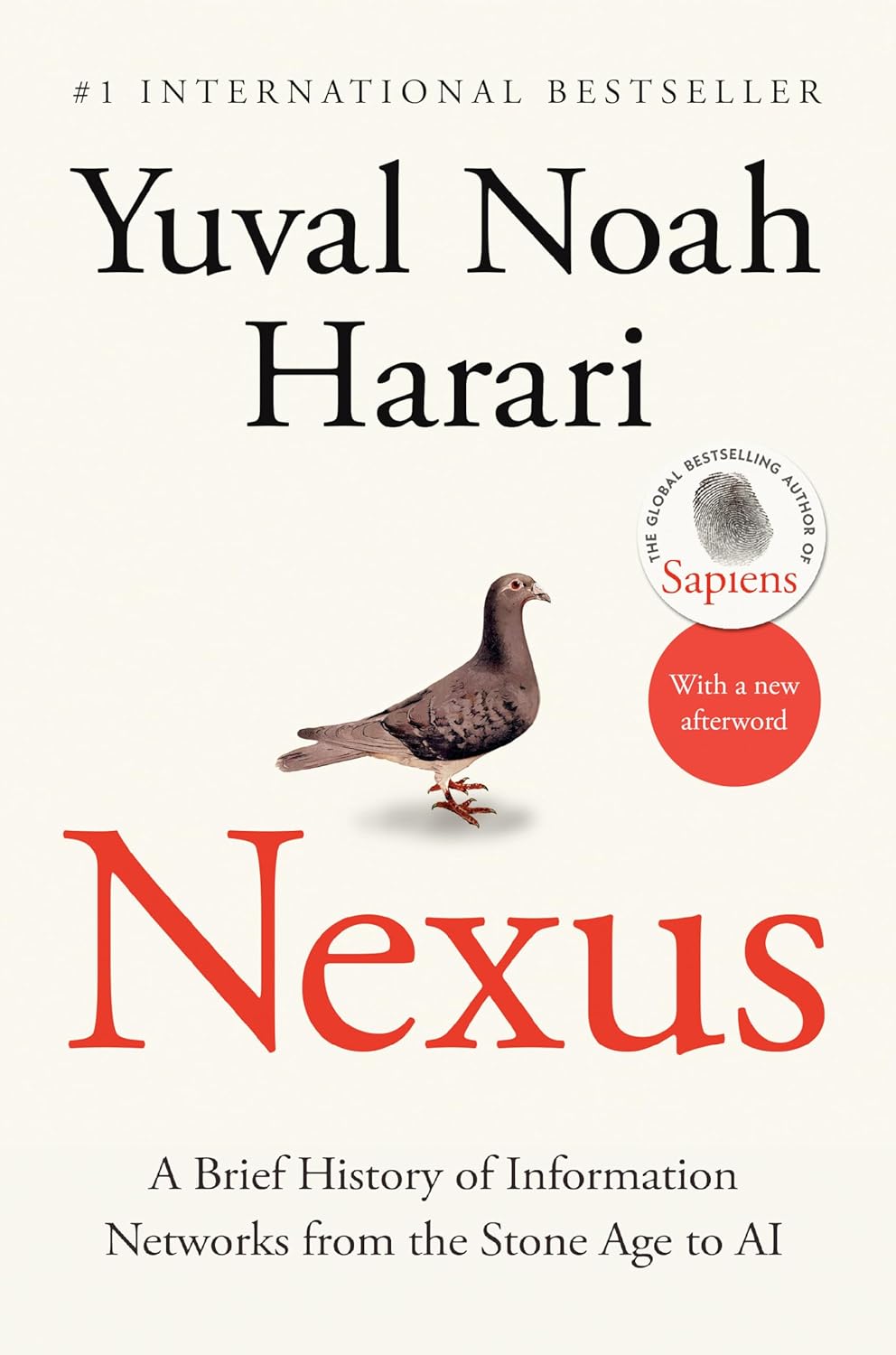

Nexus, published in 2024 by Random House, is his sharpest and most urgent work yet — a sweeping history of how humans have used information to build, sustain, and occasionally destroy their civilizations.
What makes Nexus so compelling is Harari's central argument: information is not just data, not just news, not just what you scroll past on your phone. Information is the fabric that holds societies together — or tears them apart. For most of human history, the most important information was religious scripture, dynastic genealogies, and legal codes. Today it's algorithms, training data, and the parameters of large language models.


But the underlying logic — who controls information, who decides what's true, and what stories get told — has been the same since the first humans sat around a fire and argued about which gods were real.
Harari opens with a paradox that sets the tone for the entire book. The Agricultural Revolution gave humans more food, but also more disease and social hierarchy. The Printing Press gave us the Reformation and the Scientific Revolution, but also the Holocaust and Stalin's purges — because pamphlets and newspapers are equally good at spreading truth and propaganda. The Internet gave us Wikipedia and the Arab Spring, but also QAnon and the Capitol riot.


Every Information Revolution has been a double-edged sword, and we are now holding the sharpest edge. What follows is a grand tour through five major information revolutions: the Oral Revolution, the Script Revolution, the Print Revolution, the Telecommunication Revolution, and the Digital Revolution. Harari's range is astonishing — he moves seamlessly from the Code of Hammurabi to the Byzantine Empire's postal system, from Guttenberg's press to the CIA's declassification programs, from the telegraph to TikTok's recommendation algorithm.
The connective tissue is always the same question: how do networks decide what's true, who's in charge, and what reality means? One of Nexus's most important contributions is its framework for understanding why some information networks survive and others collapse. Harari identifies three types of networks: brutalist networks that rely on violence and fear, liberal networks that rely on individual judgment and tolerance, and apocalyptic networks that rely on shared fantasies and conspiracy thinking.


The battle between these three types has shaped every era of human history, and it's shaping our era right now as AI makes it trivially easy to create realistic fake texts, fake voices, and fake videos at massive scale.
The chapter on AI is the most unsettling part of the book. Harari argues that previous information revolutions amplified human intelligence — printing presses made smart people more impactful, but they didn't replace human judgment. AI is different. Large language models don't just amplify human thought, they increasingly substitute for it. When an algorithm can write a college essay, draft a legal brief, or generate a news article, the question of what humans are actually for becomes not philosophical but urgent.


Harari doesn't predict mass unemployment so much as mass confusion — a world where nobody can agree on what is real, what is original, and what is true.
What makes Harari different from most tech critics is his refusal of simple optimism or pessimism. He doesn't think we should ban AI or embrace it blindly. Instead he argues for what he calls "liberal epistemic infrastructure" — the institutions, norms, and habits of mind that allow societies to distinguish truth from fiction. This includes independent journalism, democratic institutions, academic peer review, and most importantly, a shared commitment to honesty as a social value rather than just a personal preference.


The crisis of our time, Harari says, is not AI itself — it's the erosion of the social infrastructure that allowed humans to agree on reality in the first place.
The final chapters of Nexus turn to the future. Harari asks what happens when AI becomes the most persuasive voice in the room — when algorithms are writing not just our news and our essays, but our laws and our religious texts. He doesn't offer easy answers, but he does offer a compelling vision: the future of humanity depends not on building smarter machines, but on building stronger networks of trust, truth, and shared reality. This is not a technical problem. It's a political and moral one.


For readers who loved Sapiens, Nexus will feel familiar but sharper — more focused, more urgent, less sprawling. It's Harari at the top of his game, applying his trademark wide-angle historical lens to the most pressing question of our era. If you care about AI, about democracy, about truth, or about where the human story is heading next, this book is essential reading.
That's my take on Nexus. Do you think we can build the epistemic infrastructure fast enough to survive the AI era? Drop your thoughts in the comments below — I'd love to hear your perspective.
