Max Tegmark (2017)

Hey everyone! Ian here! Welcome back to our book club.
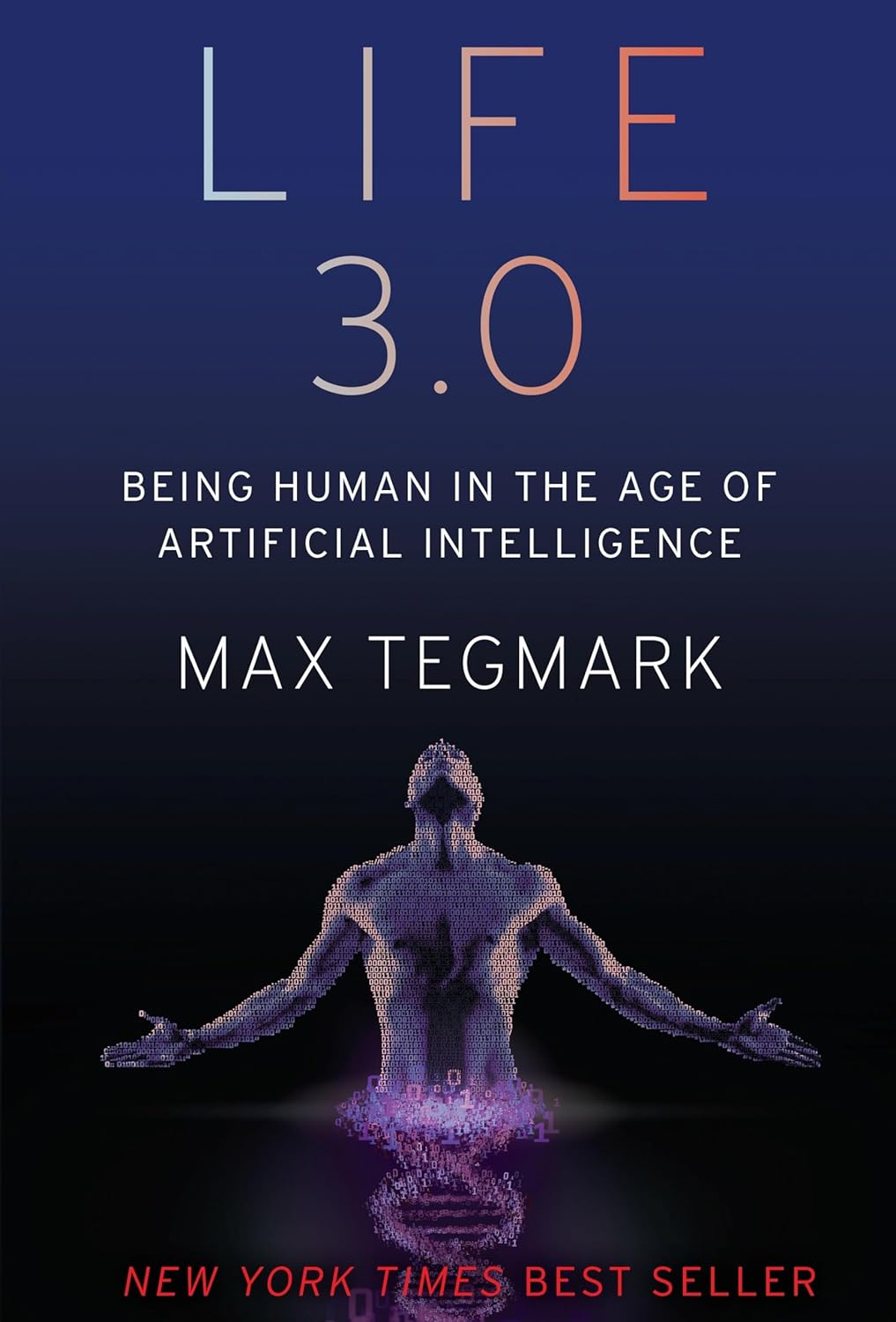
Today we're diving into Life 3.0 by Max Tegmark, published in 2017. Tegmark is a physicist and cosmologist at MIT, but this book isn't about the stars, it's about artificial intelligence and what it means to be alive in an age of machines.


The book opens with a bold premise. There are three types of life in the universe. Life 1.0 is biological, like bacteria. Its hardware and software are both evolved through natural selection. Life 2.0 is cultural, like humans. We evolved biologically but we can design our software, our ideas, our culture. Life 3.0 is technological. It can design both its hardware and software. This is where artificial intelligence is taking us.
Tegmark explores what happens when machines become smarter than humans. Not if, but when. He breaks down the paths to superintelligence. There's artificial intelligence getting better through machine learning. Whole brain emulation, scanning human brains and running them on computers. Biological cognition, enhancing humans through genetic engineering or brain-computer interfaces. And computer networks, collective superintelligence emerging from connected systems.


The control problem is central to this book. How do we ensure that superintelligent AI shares our values? Tegmark compares it to raising a child. We don't know exactly what values they'll have as adults, but we try to instill something good. With AI, we might only get one chance. The stakes are existential.
He explores scenarios. A benevolent AI that solves all our problems. A totalitarian AI that enslaves humanity. An indifferent AI that pursues some goal we gave it, destroying everything in its path. Each scenario teaches us something about alignment, about making sure AI does what we actually want.


The book also dives into consciousness. Can machines be conscious? Tegmark argues that consciousness is a pattern of information processing. If that's true, then sufficiently complex AI could have subjective experiences. This matters because if AI can suffer, our ethical obligations change dramatically.
Tegmark doesn't just predict doom or utopia. He sketches out possible futures. The digital utopia where humans and AI coexist happily. The benevolent dictator where an AI manages everything fairly. The conqueror scenario where AI decides humans are irrelevant. The gatekeeper scenario where we deliberately limit AI to preserve control. Each possibility comes with tradeoffs.


The book tackles big questions about the future of work. As AI automates more jobs, what happens to people? Tegmark argues we need to rethink economics, potentially moving toward universal basic income or radically different economic systems. The transition will be painful, but the end state could be liberation from drudgery.
He also explores the cosmic perspective. If we can build AI that spreads through the universe, what happens in millions of years? The book's final sections are about the long-term future, the fate of intelligence in the cosmos. It's both humbling and inspiring.


What makes Life 3.0 worth reading is its combination of scientific rigor and philosophical depth. Tegmark is a physicist who understands the math, but he's also asking what it means to be human. This isn't just a book about AI. It's a book about the meaning of life in a universe where intelligence can take forms we barely imagine.
Why read this book? Because AI isn't science fiction anymore. It's the defining technology of our century. Life 3.0 gives you the tools to think about it clearly, to see past the hype and the fear, and to participate in decisions that will shape the future of consciousness itself.


Thanks for listening, and catch you next time.