← Back to Gallery
0 / 17
0:00 / 4:53
How Life Works

How Life Works

Philip Ball (2023)

Introduction

A Total Reset Button

Hey everyone! Ian here! Welcome to our book review series. Today we're diving into a book that feels like a total reset button for everything you thought you knew about biology. If you've ever looked at a living thing — a flower blooming, a cell dividing, or even your own hand — and wondered "how on earth does that actually work?" this one will blow your mind in the best possible way. It reveals life to be far richer, more ingenious, and more magical than any old-school textbook ever suggested.

Meet the Author

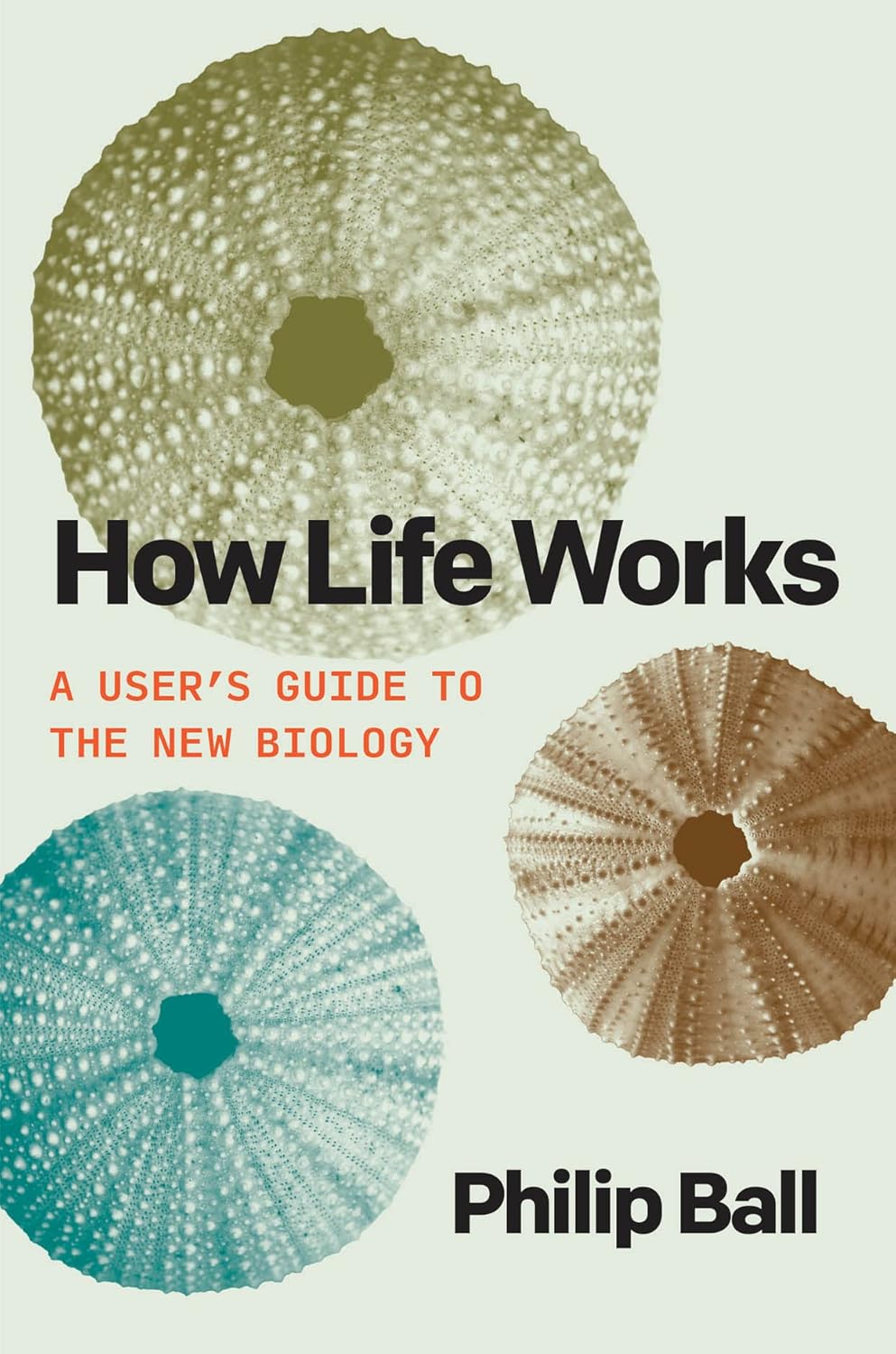
Let's meet the author. Philip Ball is one of the finest science writers working today — a physicist by training with a PhD from the University of Bristol, a chemist's background from Oxford, and more than twenty years as an editor at the journal Nature. He's written over two dozen books on everything from the history of color to the science of music and water, always blending deep research with beautiful storytelling. How Life Works: A User's Guide to the New Biology was published in November 2023 by Picador in the UK and the University of Chicago Press in the US. It's a substantial 552-page hardcover that's been called "marvelous… wide-ranging and deep" by Siddhartha Mukherjee, earned starred reviews from Publishers Weekly and Kirkus, and sits at a strong 4.21 average on Goodreads from hundreds of readers. Critics describe it as provocative, profound, and an essential primer for the quiet revolution happening in biology right now.

Author
Big Picture

The Big Picture

Here's the big picture — completely spoiler-free, because the joy is watching the old story crumble and a far more exciting one emerge.

The Old View Crumbles

For decades we've been told that life is basically a genetic blueprint: DNA is the master instruction manual, genes are the precise commands, proteins are the obedient machines, and cells are little factories dutifully carrying out the plan. Ball shows that this picture — while useful in its time — is incomplete, misleading, and in many ways just plain wrong.

Old View
Research

The New Biology

Drawing on the latest research in developmental biology, systems biology, epigenetics, non-coding RNA, protein dynamics, and cell agency, he takes us on a tour through the real, multi-layered ways life actually builds and maintains itself.

Cells as Agents

You'll explore how cells aren't passive robots but active, decision-making agents that interpret their environment, generate meaning, and shape their own destiny.

Cell Agency
Genes

Genes & Proteins

You'll see how genes are more like a versatile parts catalog than a rigid blueprint, how proteins are floppy and promiscuous rather than rigid machines, and how astonishing complexity arises through self-organization, feedback loops, and emergent processes that no single level of biology can fully control. From the molecular dance inside a single cell all the way up to tissues, organs, and whole organisms, Ball shows that life is a dynamic, adaptive process of "becoming" — not a top-down program. By the end you understand why the old metaphors of blueprints, machines, and central control just don't cut it anymore, and why the new biology is full of wonder, flexibility, and possibility.

Six Transformative Ideas

So what are the core ideas you'll walk away with? Here are the six biggest that make this book transformative.

Ideas
First Idea

Idea 1: Life Is Not a Machine

First, life is not a machine or a computer program — it's a system of many interacting levels, each with its own rules, and the whole is far more than the sum of its parts.

Idea 2: Genes Are Not Dictators

Second, genes are not dictators or blueprints; they're resources that cells use flexibly, and most of the real work happens through regulation, context, and non-genetic processes. As Ball puts it, "The old view of genes as distinct segments of DNA strung along the chromosomes like beads… was basically a kind of genetic phrenology."

Second Idea
Third Idea

Idea 3: Cells Have Agency

Third, cells have genuine agency — they sense, interpret, make choices, and pursue goals, which is why cognition may be a better way to think about life than metabolism or replication alone.

Idea 4: Proteins Are Flexible

Fourth, proteins are not rigid, perfectly tailored machines but often intrinsically disordered and promiscuous, allowing the flexibility that makes complex life possible.

Fourth Idea
Fifth Idea

Idea 5: Self-Organization

Fifth, development and form emerge from self-organizing principles and environmental cues far more than from strict genetic instructions — evolution works with a rich, creative toolkit.

Idea 6: The Magic Deepens

And sixth, understanding this new biology doesn't diminish the magic of life; it deepens our awe. Ball writes, "The growth and maintenance of living things like us is a delicate (but also robust) dance of cause and effect, cascading up and down the hierarchy of scales in space and time."

Sixth Idea
Central Goal

The Central Goal

His central goal? To replace outdated, oversimplified metaphors with a richer, more accurate picture so we can finally grasp what life really is — and what it might become. He succeeds brilliantly.

Why Read This Now?

Why does this book deserve your time right now? Because biology is in the middle of a quiet revolution that will shape medicine, biotechnology, and even how we think about ourselves and our place in the universe. In an era of gene editing, personalized medicine, and AI-designed biology, Ball gives you the clear, up-to-date map you need to understand what's actually happening — without hype or oversimplification. The writing is warm, witty, and astonishingly clear; you'll finish feeling smarter, more curious, and genuinely amazed by the ingenuity of life. It's perfect for students, science lovers, doctors, or anyone who wants to move beyond the old "DNA is destiny" story. Even if you've read Dawkins or Carroll, this feels like the essential next chapter.
Why Read
Conclusion

Life Is More Wonderful

There you have it — How Life Works, the book that reveals the true magic of biology and why life is so much more ingenious than we ever guessed. If it sounds like the kind of mind-expanding read you love, grab a copy today. You'll never look at a living thing the same way again. I'll see you in the next one. Stay curious, everyone — life is more wonderful than we thought!