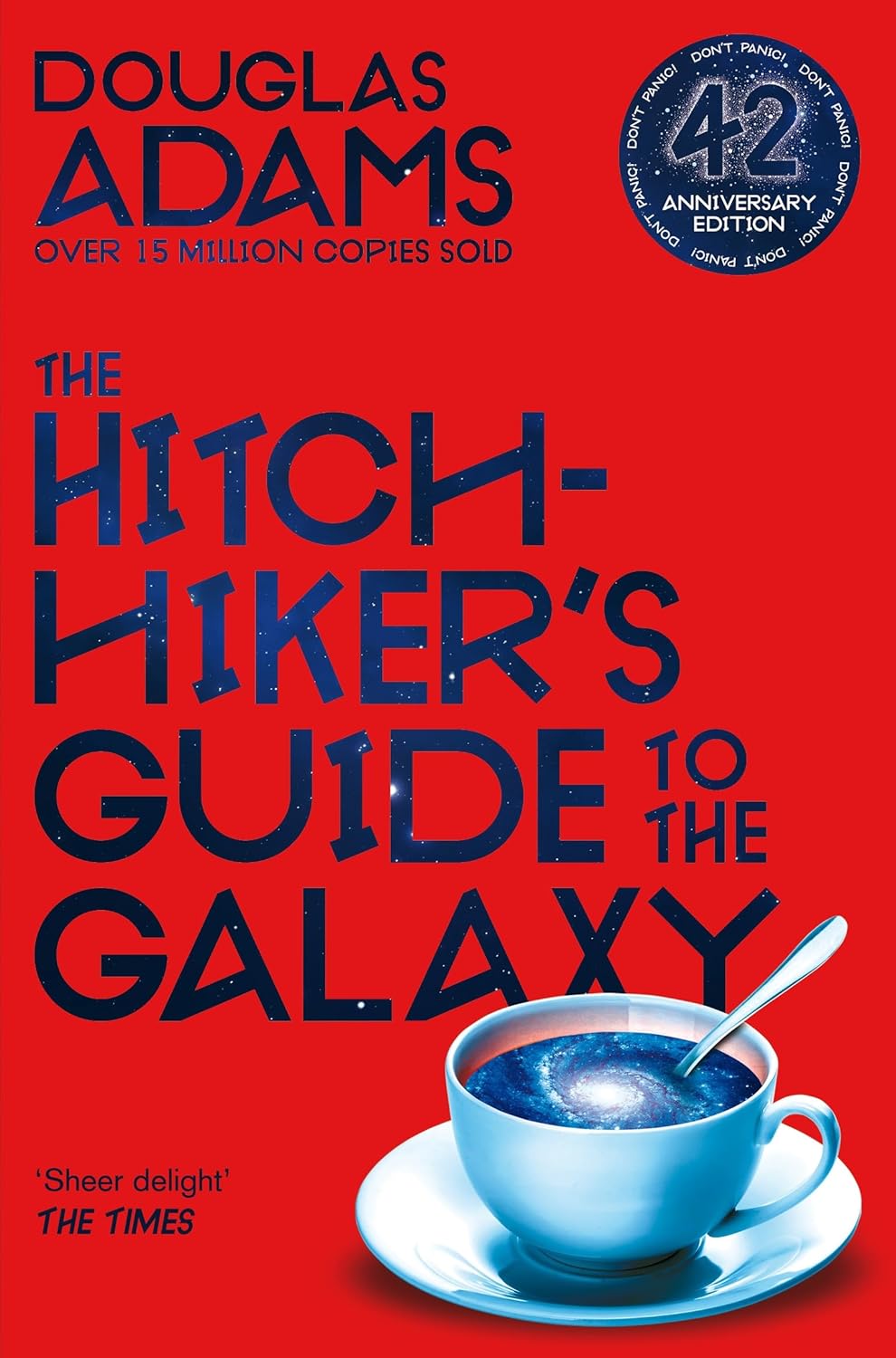
Douglas Adams (1979)

Hey everyone! Ian here. Welcome to our must-read books review. Imagine waking up one ordinary Thursday to discover your house is about to be bulldozed for a bypass—only to learn the entire planet Earth is next on the demolition list, cleared for a galactic hyperspace expressway by a fleet of bureaucratic aliens who couldn't care less.
Your only hope? A friend who's secretly an alien researcher, a towel, and a book that calmly says "Don't Panic." That's just the first five minutes of Douglas Adams' The Hitchhiker's Guide to the Galaxy—the wildly funny, mind-bending comedy that launched one of the most beloved series in sci-fi history.


If you've ever felt like the universe is absurd, random, and hilariously unfair, stick around. This book will make you laugh out loud while wondering why we're all here.
Let's talk about the author first. Douglas Adams was a brilliant British humorist, radio dramatist, and screenwriter who worked on Doctor Who and even contributed a sketch to Monty Python. The idea for the story hit him while hitchhiking through Europe in 1971 with a copy of The Hitchhiker's Guide to Europe; he wondered what a galactic version would look like.


It started as a BBC radio comedy series in 1978, then became this 216-page novel. Published by Pan Books in the UK on October 12, 1979 (and in the US the following year), it shot to number one on the bestseller lists, sold over 250,000 copies in its first three months, and eventually more than 15 million worldwide.
It's pure science-fiction comedy—absurdist, satirical, and packed with deadpan British wit. The story of The Hitchhiker's Guide to the Galaxy was told across five books, all written by Douglas Adams, which make up the "trilogy" in the classic, humorous, and deliberately inaccurate sense of the word.


The Hitchhiker's Guide to the Galaxy (1979—this review), The Restaurant at the End of the Universe (1980), Life, the Universe and Everything (1982), So Long, and Thanks for All the Fish (1984), and Mostly Harmless (1992).
Critics and fans adore it: 4.22 average on Goodreads from tens of thousands of ratings, ranked fourth in the BBC's Big Read poll, and called a cult classic that influenced everything from pop culture to tech. Some say the humor can feel too silly or rambling if you're not in the mood, but most agree it's endlessly re-readable genius.


Now, the comprehensive synopsis—spoiler-free, so you can dive in fresh. The book follows Arthur Dent, an utterly ordinary Englishman living in the West Country who's having a very bad day. His house is scheduled for demolition, and before he can even process that, he learns the whole planet is about to be vaporized by the Vogons—callous, poetry-spouting alien bureaucrats building a hyperspace bypass.
Luckily, his friend Ford Prefect (who's not actually from Guildford but from a small planet near Betelgeuse) has been posing as an out-of-work actor for fifteen years while researching for the ultimate electronic travel guide: The Hitchhiker's Guide to the Galaxy. The two hitch a ride on a Vogon ship, survive some truly terrible poetry, and are improbably rescued by the Heart of Gold—a spaceship powered by the Infinite Improbability Drive.


Stolen by the two-headed, three-armed President of the Galaxy, Zaphod Beeblebrox. Along for the ride are Trillian, the other surviving human from Earth, and Marvin, the chronically depressed robot. What follows is a whirlwind tour of the galaxy: encounters with ancient planets, impossible restaurants, paranoid androids, and the single most important question in the universe.
Adams weaves in hilarious excerpts from the Guide itself, turning the whole thing into a nonstop adventure that feels like a Monty Python sketch set in outer space.


That brings us to the book's six big key points and Adams' central goal. First, the universe is absurd, random, and doesn't care about us—and that's actually okay. Adams shows how bureaucracy, bad planning, and cosmic indifference rule everything from local councils to galactic highways.
Second, don't panic—literally. The Guide's famous advice reminds us that a cool head (and the right attitude) gets you through anything. Third, a towel is the most massively useful thing an interstellar hitchhiker can have—practical, versatile, and a symbol that resourcefulness beats fancy tech every time.


Fourth, the search for meaning is hilarious and probably pointless. As the Guide notes, "The answer to the Ultimate Question of Life, the Universe, and Everything is… 42." But good luck figuring out the question. Fifth, technology and progress are double-edged: brilliant inventions like the Infinite Improbability Drive solve problems by creating even weirder ones.
And sixth, curiosity and a sense of wonder make life worth living, even when everything's ridiculous. Adams' goal? To poke fun at humanity's self-importance while celebrating the joy of exploration, bad jokes, and just getting on with it. He nails it—turning philosophy into laugh-out-loud entertainment.


So why does this book deserve your time? It's honest, side-splittingly funny, and surprisingly deep in 2026. Strengths? The wit never stops, the characters are unforgettable (especially Marvin), and it feels fresh no matter how many times you read it. Perfect for sci-fi fans who want comedy instead of space battles, for anyone who loves sharp satire, or for readers who just need a break from serious stuff.
Even if some bits feel dated or overly silly, the core message—that the universe is vast, weird, and worth exploring with a towel and a smile—still lands perfectly. In our chaotic world of AI, bureaucracy, and endless questions, this reminder to stay curious and not panic is pure gold.


In the end, The Hitchhiker's Guide to the Galaxy isn't just a book—it's a love letter to the absurd beauty of existence. If you want to laugh until your sides hurt while pondering the meaning of life (or at least 42), grab this book today. Paperback, hardcover, or the audiobook narrated with perfect deadpan timing—any version will hook you. Drop your favorite quote or character in the comments (mine's Marvin), hit that like button if this made you smile, and subscribe for more must-read deep dives. Ian here—thanks for watching. Don't panic, keep hitchhiking, and see you next time!