Hey everyone, Ian here. Welcome...
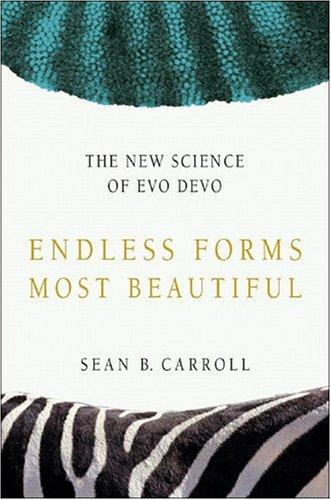
Hey everyone, Ian here. Welcome to our book review series. Today we're diving into a book that finally cracks open one of biology's biggest mysteries. How a single fertilized egg turns into the dazzling variety of animal life all around us. If you've ever stared at a butterfly wing, a zebra stripes are your own hand and wondered how evolution could sculpt such endless beauty from such simple beginnings, this one will leave you an awe. Sean B. Carroll is a pioneering molecular
Carroll is a pioneering molecular...
biologist and one of the founders of evolutionary developmental biology, evodevo. At the time of writing he was a professor at the University of Wisconsin-Madison and an investigator with the Howard Hughes Medical Institute where his lab used fruit flies to uncover the genes that build bodies. In 2005 he published endless forms most beautiful, the new science of evodevo and the making of the animal kingdom with W.W. Norton & Company. Its 368 pages of vivid accessible popular science
The book was a finalist...
that became an instant classic. The book was a finalist for the 2005 Los Angeles Times book prize in science and technology, a finalist for the 2006 National Academy of Sciences Communication Award, named a top science book of 2005 by Discover Magazine in USA Today and won the 2006 Banta prize from the Wisconsin Library Association. On Goodreads it holds a strong 4.08
On Goodreads it holds a...
average from thousands of readers, critics and scientists call it a beautiful and very important book, eye-opening, and elegant the perfect bridge between Darwin's big ideas and the molecular details of how life actually works. Here's the big picture, completely spoiler-free. For more than a century scientist's new development was the missing link in evolution, but they couldn't open the black box of the embryo. Carol shows how the new field of evodevo
All animals from worms to...
finally did it. All animals from worms to humans, share an ancient genetic toolkit, a small set of master regulatory genes, including the famous HOX genes that are nearly identical across the entire animal kingdom. These toolkit genes don't build body parts themselves. They act like switches that turn other genes on and off at precise times and places during embryonic development. Tiny changes in those regulatory switches when, where, and how strongly the toolkit genes are expressed create dramatic differences in body form. Carol walks us through
Carol walks us through stunning...
stunning real world examples, how the same genes build wings and butterflies and legs and insects, why eyes form across vastly different species using the same genetic circuit, how modular body plans let evolution tinker with segments and appendages, and how the fossil record and the Cambrian explosion finally makes sense when you understand
He connects embryology, genetics and...
these developmental rules. He connects embryology, genetics and paleontology into one seamless story, showing that evolution doesn't usually invent brand new genes, it reuses and tweaks the same ancient ones in new ways. By the final chapters you see exactly what Darwin meant when he closed on the origin of species with the phrase that gives the book its title, endless forms most beautiful and most wonderful. So what are the core ideas you'll walk away with? Here are the five
First, there's a universal genetic...
biggest. First, there's a universal genetic toolkit shared by nearly all animals, revealing our deep common ancestry. Second, evolution of form happens mainly through changes in regulatory DNA, the switch is not by creating new genes, as Carol puts it, evolution of form is very much a matter of teaching very old genes new tricks. Third, animal bodies are built in a modular way with repeating parts that can be modified, duplicated or lost, allowing huge variety from simple starting
Fourth, complex structures like eyes...
plans. Fourth, complex structures like eyes, limbs, hearts and wings evolved by tweaking ancient genetic circuits rather than inventing everything from scratch. And fifth, evodavo completes the modern synthesis of evolution, showing that development and natural selection together explained both the unity and the staggering diversity of life. Carol's central goal was to make this revolutionary science accessible and exciting, and he absolutely succeeds turning what could be dry genetics into a page-turning story of wonder. Why does this book deserve your
Why does this book deserve...
time right now? Because it transforms the way you see every animal on Earth, including us. In an era when biology feels increasingly complex, Carol shows the surprising simplicity and elegance underneath it all. The writing is clear, the examples are unforgettable, and the illustrations help you picture exactly how these genetic switches work. It's perfect for students, nature lovers, curious adults, or anyone who wants to feel the grandeur in Darwin's vision all over again.
Even 20 years later, the...
Even 20 years later, the core ideas remain rock solid and continue to shape modern biology. There you have it. Endless forms most beautiful. The book that reveals how from so simple a beginning, evolution has produced the endless beautiful forms all around us. Grab a copy today, you'll never look at a butterfly, a fish, or your own body, the same way again. Drop a comment below what animal feature fascinates you most. Hit like if this review sparked your curiosity, subscribe for more, and I'll see you in the next one. Stay curious everyone.
💬 Reader Thoughts
Loading comments...