← Back to Gallery
0 / 11
0:00 / 4:30
The Eighth Day of Creation

The Eighth Day of Creation

Horace Freeland Judson (1979)

Welcome

Welcome

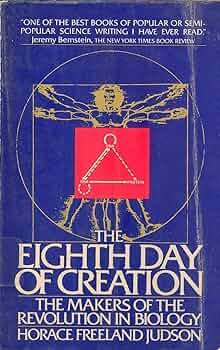
Hey everyone! Ian here! Welcome back to our book review! Today we're diving into what many scientists call the greatest history of science book ever written: Horace Freeland Judson's The Eighth Day of Creation, published in 1979. This isn't just a book about molecular biology, it's an intimate portrait of the scientists who cracked the genetic code and revolutionized our understanding of life itself. If you want to understand how modern biology was built, this is essential reading.

The Author

Horace Freeland Judson was a historian of science and journalist who spent years interviewing over 100 molecular biologists between 1970 and 1975. Unlike typical science writers, Judson didn't just report discoveries, he captured the personal rivalries, failed experiments, and moments of insight that shaped the field. Published by Simon and Schuster, the book spans 686 pages and took Judson five years to complete. It won the National Book Award in Science in 1980 and remains in print decades later because it's unmatched in its depth and honesty.

Horace Judson
DNA Structure

Part 1: DNA Structure

Judson organizes his narrative around three major revolutions in molecular biology. Part One covers the discovery of DNA's structure from 1944 to 1953. It begins with Oswald Avery's 1944 experiment showing DNA, not protein, was the genetic material. Most scientists dismissed this because DNA seemed too simple. The story builds through Linus Paulings Alpha Helix discovery to the race for DNA's structure.

The Double Helix

James Watson and Francis Crick at Cambridge, using Rosalind Franklin's X-ray data without her full knowledge, proposed the double helix in 1953. Watson later wrote: "The double helix was too pretty, not to be true." Judson doesn't sanitize the controversy. He shows Franklin was marginalized and her contribution underappreciated until years later.

Watson Crick Franklin
Genetic Code

Part 2: The Genetic Code

Part Two follows the cracking of the genetic code from 1953 to 1966. This was the biochemical puzzle of the century. How do four DNA bases specify 20 amino acids? Sydney Brenner and Francis Crick proposed messenger RNA as the intermediary. Marshall Nirenberg and Har Gobind Khorana led competing labs that deciphered the code through painstaking experiments.

Code Complete

By 1966, the code was complete. Three nucleotides specify each amino acid with redundancy built in. The same code runs through all life, bacteria to humans pointing to common ancestry.

Nirenberg Khorana
Gene Regulation

Part 3: Gene Regulation

Part Three explores gene regulation and the birth of genetic engineering from 1961 to the 1970s. Jacques Monod and Francois Jacob discovered the operon in bacteria. Genes could be switched on and off. This explained how cells with identical DNA differentiate into different tissues. Then came restriction enzymes and recombinant DNA technology. Scientists could cut and splice DNA, creating hybrid organisms. These discoveries won Nobel Prizes and launched biotechnology.

Judson's Achievements

Judson achieves several remarkable goals. First, he makes complex biochemistry accessible through storytelling. You understand DNA structure, not as abstraction, but as something scientists struggled to visualize. Second, he shows science is deeply human. Watson and Crick were racing Pauling, Brenner and Jacob brainstormed in Cambridge pubs. Third, he documents the international collaboration and competition that drove progress.

Biotechnology
Modern Genetics

Preserving History

Fourth, he preserves voices of scientists now passed away. Fifth, he demonstrates how molecular biology transformed medicine, agriculture, and our self-understanding.

Why Read Today

Why read this book today? Because The Eighth Day of Creation explains the foundations of modern biology more clearly than any textbook. It demonstrates how science actually works. Observation, hypothesis, experiment, revision. The themes, decoding nature's secrets, international collaboration, ethical implications of powerful knowledge remain vital. This is ideal for anyone curious about biology, history of science, or how revolutionary ideas emerge from human ambition and intellect. Modern genetics, CRISPR, personalized medicine, all build on foundations documented here.
Modern Relevance
Conclusion

Conclusion

Judson's masterpiece isn't just history. It's a guide to understanding scientific creativity. Whether you accept every implication or not, this book provides essential context for biology's transformation. I highly recommend reading it. It's remarkably engaging despite its length. You can find editions online or at your local bookstore. Pick it up and let me know what you think in the comments. Thanks for watching, and I'll catch you in the next review!