← Back to Gallery
0 / 14
0:00 / 4:04
A Brief History of Time

A Brief History of Time

Stephen Hawking (1988)

Introduction

Introduction

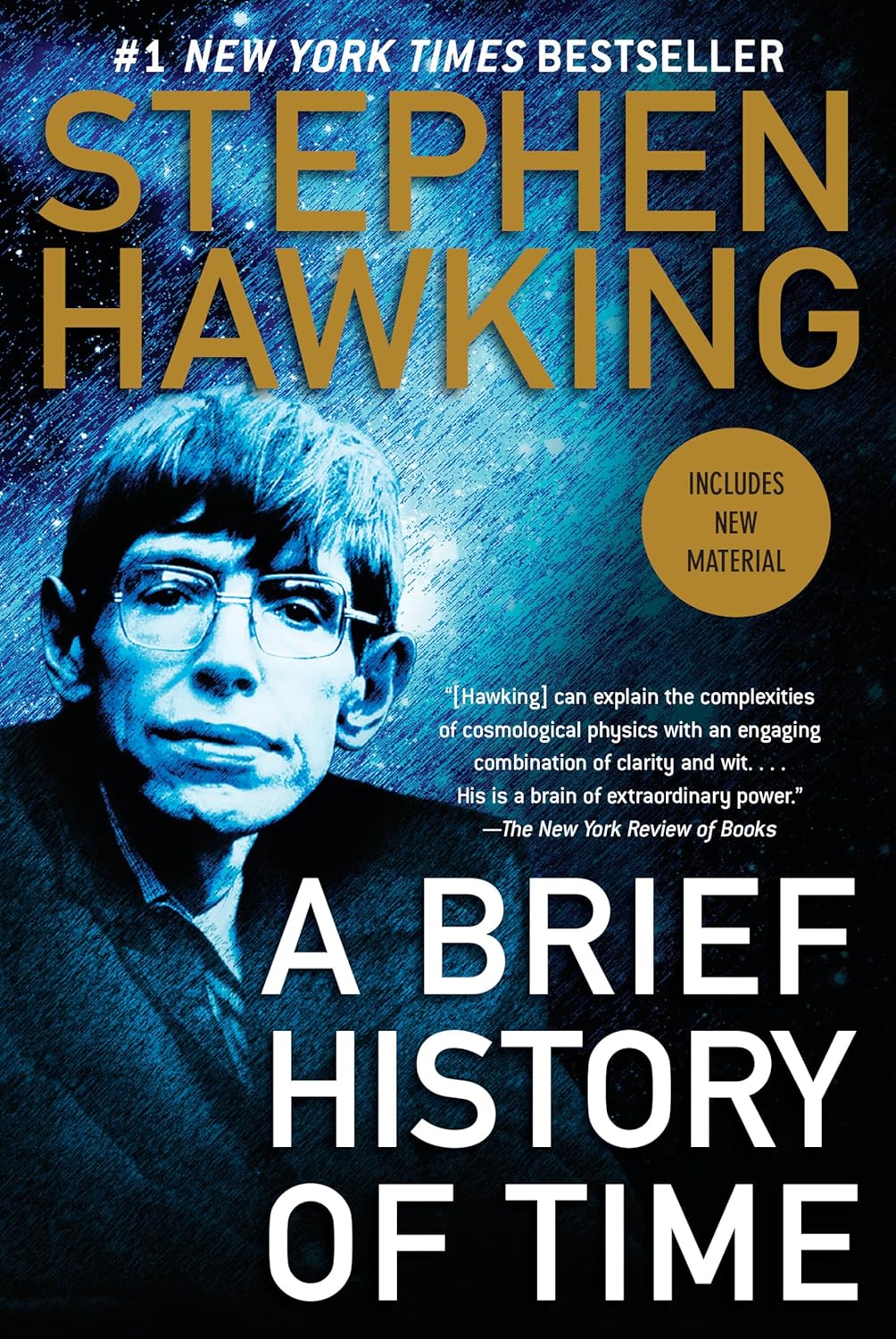
Hey everyone, Ian here. Welcome back to our book review. Today we're exploring A Brief History of Time by Stephen Hawking, first published in 1988. This is one of the bestselling science books of all time. Hawking was a theoretical physicist at Cambridge, and this book made cosmology accessible to millions of people who'd never thought about black holes or the Big Bang.

The Big Questions

The book opens with a question that's both simple and profound. Where did the universe come from? Where is it going? Hawking guides us through our current understanding of space, time, and the cosmos, writing with wit and clarity that makes the complex feel approachable.

Universe
Astronomy

Ancient Cosmologies

He starts with ancient cosmologies. Aristotle believed in a stationary Earth at the center of the universe. Ptolemy refined this with epicycles. Then came Copernicus, who put the Sun at the center. Kepler discovered planets move in ellipses, not circles. Galileo saw moons orbiting Jupiter, proving not everything revolved around Earth. Newton unified it all with gravity, showing the same laws govern falling apples and orbiting planets.

Einstein's Revolution

Then Einstein changed everything. Special relativity showed that time isn't absolute. It flows differently depending on how fast you're moving. The speed of light is the cosmic speed limit. As you approach it, time slows down. General relativity went further. Gravity isn't a force pulling things together. It's the curvature of spacetime caused by mass and energy. Mass tells space how to curve. Space tells mass how to move.

Einstein
Galaxies

The Expanding Universe

Hawking explains the expanding universe. Edwin Hubble discovered that distant galaxies are moving away from us. The farther away, the faster they're receding. This implies the universe is expanding. Run the clock backward, and everything converges at a point. The Big Bang.

Black Holes

The book dives into black holes. When massive stars collapse, they can become so dense that nothing escapes, not even light. The boundary is called the event horizon. Once you cross it, you're trapped forever. At the center is a singularity, a point of infinite density where the laws of physics break down.

Black Hole
Hawking

Hawking Radiation

Hawking's own contributions feature prominently. He showed that black holes aren't completely black. They emit radiation, now called Hawking radiation, due to quantum effects near the event horizon. This was revolutionary. It connected quantum mechanics, the physics of the very small, with general relativity, the physics of the very large.
The Arrow of Time

The book explores the nature of time itself. Why does time seem to flow in one direction? Hawking connects this to entropy, the measure of disorder in a system. The second law of thermodynamics says entropy always increases. This gives time its arrow, its directionality.

Time
Big Bang

The Origin of the Universe

He discusses the origin of the universe. The Big Bang theory describes what happened after the beginning, but not the beginning itself. At the singularity, all our physical theories break down. Hawking worked on ways to remove the singularity, using quantum gravity.

The Anthropic Principle

The book touches on the anthropic principle. Why is the universe fine-tuned for life? The fundamental constants seem perfectly calibrated. If they were slightly different, stars couldn't burn, carbon couldn't form, we couldn't exist. Hawking explores different explanations, from divine design to the multiverse.

Cosmos
Future

The Future of the Universe

He discusses the future of the universe. Will it expand forever? Will it collapse back in a Big Crunch? The evidence now suggests eternal expansion, an ever-cooling universe where eventually even black holes evaporate and the cosmos becomes cold and dark.

Remarkable Accessibility

What makes A Brief History of Time remarkable is its accessibility. Hawking wanted to explain these ideas to everyone. The book contains no equations, just concepts explained through thought experiments and analogies. He famously said each equation would halve the sales.

Book
Stars

Why Read This Book?

Why read this book? Because the universe is stranger and more beautiful than we imagine. Black holes, warped time, the Big Bang, these aren't just abstractions. They're real features of the cosmos we inhabit. Hawking's book is an invitation to understand your place in the universe.

Final Thoughts

Thanks for listening, and catch you next time.

End