Walter Isaacson (2003)

Hey everyone! Ian here! Welcome to our book review series. Today we're going back to the very roots of the American experiment with a book that feels like it was written for right now. If you've ever wondered how a runaway apprentice printer with almost no formal education could become one of the most influential figures in world history—shaping everything from electricity to democracy to the very idea of the self-made American—this biography will make you laugh, think, and feel genuinely inspired about what one curious, practical human being can accomplish.
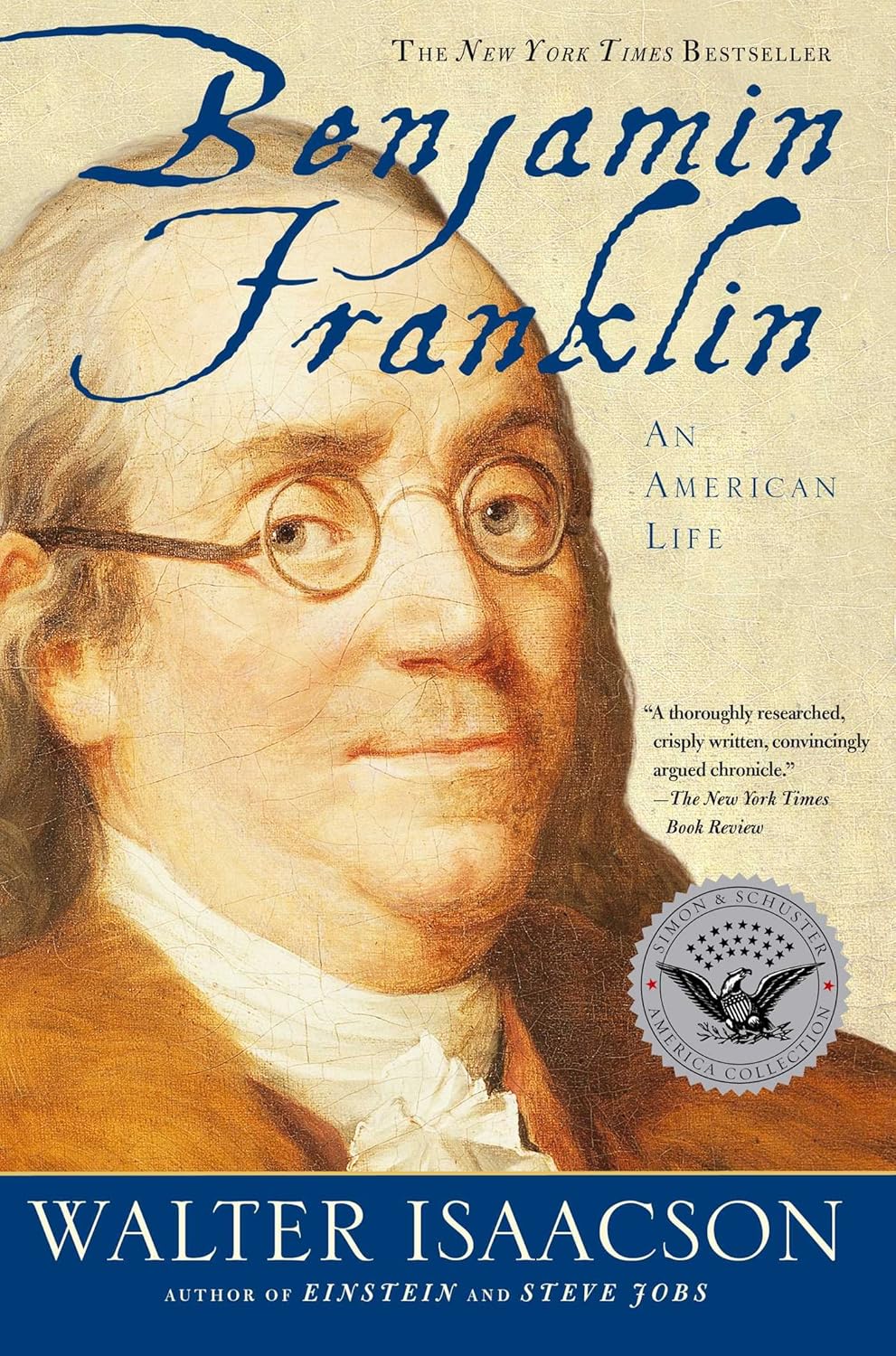
Walter Isaacson is the master biographer of our age—the same writer who later gave us Steve Jobs, Leonardo da Vinci, Einstein, and Jennifer Doudna. Back in 2003, when he tackled Benjamin Franklin, he was already known for turning complex lives into page-turning stories that reveal bigger truths about human nature and society. Benjamin Franklin: An American Life was published on July 1, 2003, by Simon & Schuster. It's a substantial 590-page narrative (some editions list 603) that shot onto the New York Times bestseller list and has held a steady 4.05 average on Goodreads from tens of thousands of readers. Critics loved it: the New York Times called it "well-organized, highly user-friendly... a fitting reflection of Franklin's sly pragmatism," while others praised its crisp writing, fresh insights, and balanced portrait. It's widely regarded as one of the best single-volume biographies of Franklin ever written—readable, fair, and full of life.


Here's the big picture—completely, because Franklin's story is too rich to rush. Isaacson follows Franklin chronologically from his birth in 1706 as the fifteenth of seventeen children in a working-class Boston family, through his teenage escape to Philadelphia with nothing but a few coins and a loaf of bread. You watch him build a printing empire, launch Poor Richard's Almanack, invent the lightning rod and the Franklin stove, found the first public library, the first fire department, the University of Pennsylvania, and a thousand other practical institutions that still shape American life.
The book tracks his two long stays in London as a colonial agent, his pivotal years in Paris as America's most famous diplomat during the Revolution, and his final decades back home helping draft the Declaration of Independence, negotiate the peace treaty with Britain, and broker the great compromises at the Constitutional Convention. Isaacson weaves in Franklin's personal side too—his complicated marriage to Deborah, his relationships with his children and grandchildren, his friendships, his flirtations in Paris, and his lifelong quest for moral self-improvement.


It's not a dry timeline; it's the story of a man who never stopped experimenting—with electricity, with politics, with his own character—and who treated every problem like a puzzle he could solve through reason, wit, and hard work.
So what are the core ideas and lessons you'll walk away with? Here are the six biggest that make this book timeless. First, relentless self-improvement works. Franklin's famous list of thirteen virtues—temperance, silence, order, resolution, frugality, industry, sincerity, justice, moderation, cleanliness, tranquility, chastity, and humility—isn't just quaint advice; it's a practical system he used to turn a flawed kid into a moral and civic powerhouse. As Isaacson notes, Franklin kept a little book to track his progress, admitting he never fully mastered humility but kept trying anyway.

Second, practical science and invention serve the public good. Franklin gave away his patents and refused to profit from the lightning rod, believing knowledge should be free.
Third, compromise isn't weakness—it's the engine of democracy. At the Constitutional Convention, Franklin's tone of moderation and conciliation helped bridge deep divides; Isaacson writes, "More important than his specific ideas was his tone of moderation and conciliation." Fourth, the American character Franklin helped create blends liberalism (public projects for the common good), conservatism (self-reliance and skepticism of handouts), and populism (mistrust of aristocratic privilege).


Fifth, tolerance and reason beat dogma every time. Franklin's deism and hatred of arbitrary power—whether from kings, churches, or mobs—shaped his lifelong fight for liberty and against tyranny.
And sixth, a life of usefulness is the highest calling. Franklin famously said he wanted his tombstone to read simply that he was "Benjamin Franklin, Printer," because he measured himself by what he built for others, not titles or wealth. Isaacson's central goal was to show why Franklin—the Founding Father who "winks at us"—still feels so modern and so American, and he nails it by letting Franklin's own wit, pragmatism, and humanity shine through every page.


Why does this book deserve your time right now? Because in our polarized, fast-moving world, Franklin's blend of optimism, practical problem-solving, and willingness to compromise feels like a masterclass we desperately need. Isaacson doesn't whitewash the flaws—Franklin could be vain, distant as a father, and sometimes too eager to please powerful men—but he shows how those very human imperfections made Franklin's triumphs even more impressive.
The writing is lively, the research is rock-solid, and the story never drags. Whether you're a history buff, a student of leadership, an entrepreneur, or just someone who wants to live a more useful, curious life, this book will leave you energized and wiser. Even twenty-plus years after publication, its insights about character, democracy, and the power of reason feel freshly urgent.


There you have it—Benjamin Franklin: An American Life, the definitive biography of the most approachable, inventive, and democratic of our Founding Fathers. If you want to understand where the American dream really came from—or just enjoy one of the most entertaining lives ever lived—grab a copy today. You'll come away wanting to start your own list of virtues. Drop a comment below: which of Franklin's thirteen virtues do you struggle with most, or which invention of his amazes you the most? Hit like if this review made you want to dive in, subscribe so you never miss our next deep dive, and I'll see you in the next one. Stay curious, keep experimenting, and remember—sometimes the greatest revolutions start with nothing more than a runaway kid, a printing press, and an unshakeable belief that reason and hard work can improve the world. Thanks for watching!