David Deutsch (2011)

Hey everyone, Ian here! Welcome to our must-read books series, where we explore the titles that genuinely shift how we see the world. Today I'm diving into a book that will make you feel like humanity's greatest adventure is just getting started. If you've ever wondered whether progress has limits or if we can truly solve the biggest problems facing us, stick around—because The Beginning of Infinity by David Deutsch argues that the only real limits are the ones we choose to accept.
Let's set the stage. David Deutsch is a physicist at Oxford University and a pioneering figure in quantum computation—he literally helped invent the field of quantum computing. He's also a passionate advocate for the many-worlds interpretation of quantum mechanics.


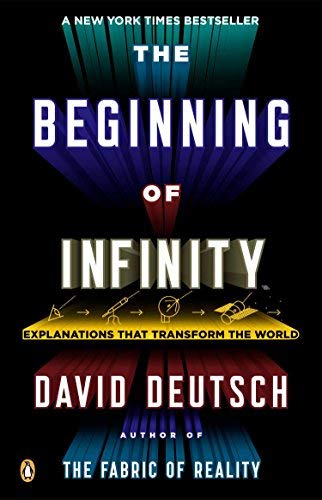
Back in 1997 he wrote the groundbreaking The Fabric of Reality, which wove together quantum physics, evolution, epistemology, and computation. The Beginning of Infinity, published in 2011 by Allen Lane in the UK and Viking in the US, is his follow-up—about 496 pages of popular science and philosophy that feels like a conversation with one of the sharpest minds alive.
It landed on the New York Times notable books list and has earned a solid 4.17 average on Goodreads from thousands of readers. Critics called it "brilliant and exhilarating," "profound," and "thought-provoking," though some noted its ambitious scope can feel wide-ranging. Overall, it's hailed as one of the most original and hopeful books of the twenty-first century.


Now for the big picture—here's what the book is really about, spoiler-free of course, because this is non-fiction at its most expansive. Deutsch takes us on a sweeping journey through the nature of knowledge itself. He starts by asking what makes an explanation a good one: it has to be hard to vary while still accounting for the facts, and it often reaches far beyond the problem it was created to solve.
From there he shows how most of human history was stuck in "static societies" that relied on authority, tradition, or bad explanations that were easy to tweak whenever reality didn't fit. Then came the Enlightenment—the moment we embraced criticism, conjecture, and the rejection of authority in favor of seeking better explanations.


That shift, Deutsch says, was the true beginning of infinity: an open-ended explosion of knowledge that has no theoretical upper bound. He explores how this process works in science, where instruments and experiments don't give us raw experience but help us test and refine our theories.
He compares biological evolution—genes as replicators that create adaptations—with human knowledge creation, where ideas are replicators that can achieve explanatory reach no gene ever could. Along the way he dives into reductionism versus emergence, showing that explanations at every level can be fundamental.


He explains universality—how certain systems, once they hit a certain threshold, can do anything that's physically possible, whether it's computation, construction, or knowledge growth itself. There's a fascinating section on artificial intelligence and why true creativity remains unsolved.
Then comes the heart of the optimism: Deutsch's Principle of Optimism. He argues that all evils—every problem we face—stem from insufficient knowledge, and that with the right knowledge every problem is soluble. No fundamental barriers exist except the laws of physics.


He applies this lens to the multiverse and quantum theory, showing how the many-worlds picture actually makes our explanations stronger and more testable. He extends the same thinking to politics—arguing for open societies where bad ideas and bad leaders can be removed easily.
By the end, Deutsch leaves you with the exhilarating realization that we are not at the end of history or the end of science—we are genuinely at the beginning of an infinite process of knowledge creation, problem-solving, and human flourishing. All progress comes from the quest for good explanations. Problems are inevitable but soluble.


Why does this book deserve your time right now? Because in an age of rapid change, uncertainty, and sometimes doom-and-gloom headlines, Deutsch offers a profoundly rational, evidence-based optimism that feels refreshing and empowering. It's not fluffy positivity—it's grounded in the deepest understanding of how knowledge actually grows.
If you love big ideas, science, philosophy, or just want to feel hopeful about humanity's future, this is for you. It's dense in the best way: every page rewards careful reading, yet the writing is clear, conversational, and often witty. You'll come away seeing the world differently—more creatively, more critically, and far more optimistically.


So there you have it—the book that shows we're not at the end of anything; we're at the very beginning of infinity. If you haven't read it yet, grab a copy today. You won't regret it. Thanks for watching, everyone—go create some good explanations of your own. I'll see you in the next one!